
John Singer Sargent was born January 12, 1856, in Florence, Italy, to American expatriate parents. His father, Dr. FitzWilliam Sargent, had been an eye surgeon in Philadelphia. His mother, Mary Newbold Singer, was an amateur artist. After their first child died at age two, the couple left America heartbroken and became nomadic, traveling between Italy, France, Germany, and Switzerland. Sargent grew up speaking Italian, German, French, and English. His mother encouraged drawing from an early age, giving him sketchbooks and arranging watercolor lessons with German landscape painter Carl Welsch when he was thirteen.
He received little formal schooling due to the family’s constant movement. His father tutored him in languages, history, arithmetic, and music. Sargent became an accomplished pianist. In 1873, he briefly attended the Accademia delle Belle Arti in Florence. In May 1874, at age eighteen, he moved to Paris and entered the atelier of fashionable portrait painter Carolus-Duran. He also enrolled at the École des Beaux-Arts to study drawing. Carolus-Duran taught his students to work directly on canvas with loaded brushes, applying paint au premier coup (at the first touch), a technique that encouraged bold, painterly style. In 1877, Carolus-Duran invited Sargent to help paint a ceiling decoration for the Luxembourg Palace.
Sargent began exhibiting at the Paris Salon in 1877. He received an Honorable Mention in 1879 for his portrait of Carolus-Duran and a second-class medal in 1881. He traveled to Spain in 1879 to copy Velázquez at the Prado, to Holland in 1880 to study Frans Hals, and to Venice multiple times. His early work combined technical virtuosity with atmospheric experimentation. In 1882, he painted The Daughters of Edward Darley Boit, a haunting group portrait that felt distinctly modern.
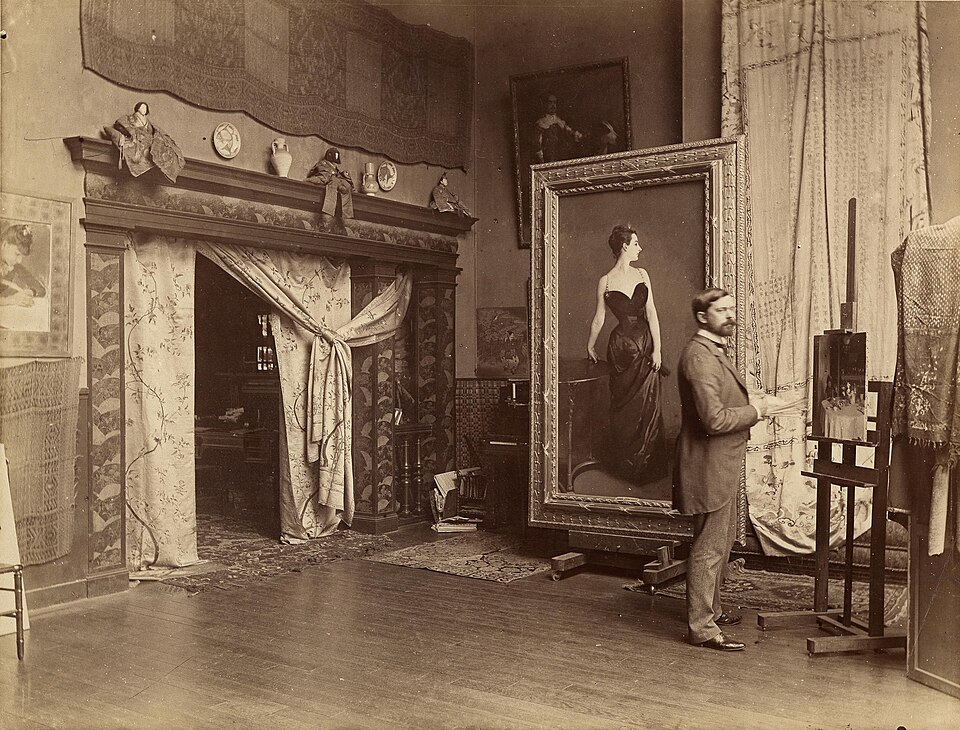
In 1883, he began work on his portrait of Madame Pierre Gautreau, an American woman living in Paris known for her beauty and unconventional style. The painting, exhibited at the 1884 Paris Salon as Portrait of Madame X, caused immediate scandal. The original version showed one strap of her black gown fallen off her shoulder, suggesting impropriety. Critics attacked the work as provocatively erotic. Sargent later repainted the strap in its proper position, but the damage was done. In 1885, he left Paris for London.
In England, his career recovered. Carnation, Lily, Lily, Rose (1885-1886), painted during summers in the Cotswolds village of Broadway, showed two girls lighting Chinese lanterns at dusk. The work was a success. By the 1890s, he had become the leading society portrait painter of the Edwardian era. His clients included Theodore Roosevelt, Woodrow Wilson, Henry James, Dame Ellen Terry, and numerous Vanderbilts, Astors, and Rockefellers. He painted with dazzling technical virtuosity, capturing not just likeness but character and social status.
Around 1907, exhausted by portrait commissions, he largely abandoned the genre to focus on watercolors and mural projects. He painted landscapes throughout Europe and the Middle East. From 1890 to 1919, he worked on murals for the Boston Public Library. He also created murals for the Museum of Fine Arts, Boston (1916-1925) and Harvard’s Widener Library (1921-1922). In 1918, he was commissioned to document World War I, resulting in Gassed (1919), showing blinded soldiers being led from the battlefield.
Sargent never married and remained private about his personal life. Recent scholarship suggests he was homosexual, pointing to his close friendships with men like artist Albert de Belleroche, his previously hidden male nudes, and the psychological complexity of his portraits. He died in London on April 15, 1925, at age 69. He remained an American citizen throughout his life. Memorial exhibitions were held in Boston and at the Royal Academy, Metropolitan Museum of Art, and Tate Gallery in 1926.
His strengths: unmatched technical virtuosity combining Old Master influence with modern sensibility, ability to capture both physical likeness and psychological essence of sitters, mastery of light and color creating luminous surfaces, bold compositional innovation challenging traditional portraiture conventions.
Career highlights: roughly 900 oil paintings and over 2,000 watercolors created during his career, Portrait of Madame X becoming one of the most famous portraits in art history despite initial scandal, becoming the leading society portrait painter of the Edwardian era with clients including presidents and royalty, major mural commissions at Boston Public Library, Museum of Fine Arts Boston, and Harvard University, work held in Metropolitan Museum of Art, Tate, National Gallery, and major museums worldwide.
99% Brushwork:🎨🟨🟪🔝The Daughters of Edward Darley Boit











Leave a Reply