
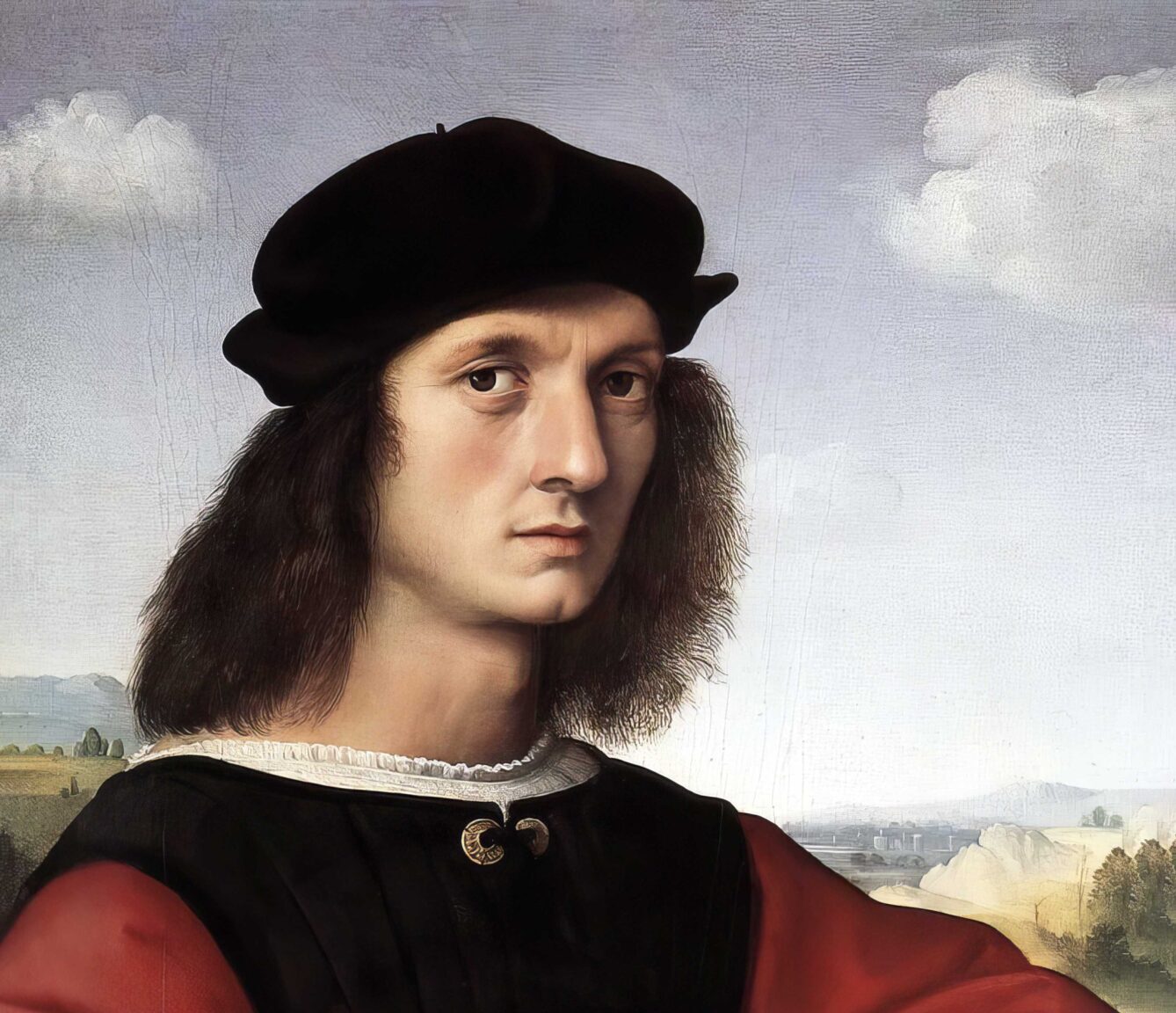
Raffaello Sanzio da Urbino was born on April 6, 1483, in Urbino, a small but unusually cultured city-state in central Italy. His father, Giovanni Santi, was court painter to the ruling Montefeltro family: a competent artist but more importantly an educated man of letters who was acutely aware of the most advanced painters of his generation, from Mantegna and Perugino to the great Flemish masters. The court of Urbino was intimate enough that young Raphael grew up integrated into its circle of humanist culture rather than on its fringes, an upbringing that shaped his social ease as much as his eye. Giovanni died when Raphael was eleven, and the boy inherited his father’s workshop while his uncle managed its affairs. He was already, by most accounts, technically extraordinary.
He trained under Pietro Perugino in Perugia, absorbing his teacher’s serene, crystalline compositions and his command of perspective. Perugino’s Giving of the Keys to St. Peter, painted in the Sistine Chapel in 1481, was the direct model for Raphael’s first major independent work, The Marriage of the Virgin (1504), a painting in which the student quietly surpasses the teacher. The temple in the background, receding into the distance with mathematical precision, announces an ambition that Perugino never quite had. By age seventeen, Raphael was already being called a master.
In 1504 he left for Florence, where he spent four formative years studying Leonardo da Vinci and Michelangelo. From Leonardo he took atmospheric tenderness, pyramidal figure groupings, and psychological interiority. From Michelangelo he took monumental physical presence. The result was a series of Madonnas unlike anything being produced in Italy at the time: figures of immense calm grandeur placed in open, luminous landscapes. La Belle Jardinière (1507), showing the Virgin seated in a meadow with the Christ child and the young John the Baptist, remains among the most quietly perfect of these works. He also produced Saint George and the Dragon during this period, a compact masterwork of narrative clarity that eventually found its way to the Imperial Hermitage in St. Petersburg before being acquired by the National Gallery of Art in Washington.
In 1508, Pope Julius II summoned him to Rome. Raphael was twenty-five, with no experience of large-scale fresco work. It was likely Bramante, the great architect then redesigning St. Peter’s Basilica and a distant relation from just outside Urbino, who recommended him. Julius had decided to abandon the rooms already being painted by other artists and hand the entire suite to this young man. His first fresco for the papal chambers was The Disputation of the Holy Sacrament, a vision of heavenly and earthly figures converging around the Eucharist. It so impressed the Pope that Julius dismissed the other painters and gave Raphael sole command of all four rooms.
The second fresco Raphael completed in the Stanza della Segnatura was The School of Athens, executed between 1509 and 1511. It was the philosophical counterpart to the Disputation: where one celebrated revealed truth, the other celebrated reasoned inquiry. Raphael populated a grand barrel-vaulted hall, its architecture echoing Bramante’s designs for St. Peter’s, with roughly fifty philosophers, mathematicians, and scientists of ancient Greece. Plato and Aristotle stand at the center, given the faces of Leonardo da Vinci and the ideal philosopher respectively, their gestures encoding opposing worldviews in a single image. Heraclitus broods alone in the foreground, modeled on Michelangelo, added after Raphael had glimpsed the Sistine ceiling taking shape down the hall. Pythagoras writes on the lower left. Euclid stoops with a compass on the lower right, wearing the face of Bramante. Raphael included himself at the far right edge, glancing out toward the viewer. The composition organizes fifty figures across a receding marble floor with such precision that nothing crowds, nothing is lost, and the eye moves from periphery to center and back again without effort.
While the Stanze frescoes were still in progress, Julius II died in 1513 and was succeeded by Leo X, the Medici pope, who extended Raphael’s commissions rather than reducing them. The Sistine Madonna (1512/13), painted for the church of San Sisto in Piacenza, belongs to this period: the Virgin and Christ child hovering on clouds above two famously sullen putti, an altarpiece whose luminous gravity sets it apart from every other Madonna of the era. The Triumph of Galatea (1512), painted for the banker Agostino Chigi’s villa on the banks of the Tiber, was his only major mythological composition and one of the finest evocations of classical antiquity produced during the Renaissance. The Portrait of Pope Julius II, completed just before the Pope’s death, shook contemporaries who claimed they could feel Julius’s formidable temperament emanating from the paint. The Portrait of Baldassare Castiglione (c. 1514/15), now in the Louvre, remains among the supreme portraits of the Renaissance, a study in subdued intelligence and aristocratic restraint that influenced Rembrandt and Titian alike.
By this period, Raphael was running a workshop of roughly fifty assistants who executed frescoes and altarpieces from his detailed drawings. Leo X appointed him chief architect of St. Peter’s Basilica following Bramante’s death in 1514, and also commissioned a set of ten tapestry cartoons depicting the Acts of the Apostles for the Sistine Chapel, woven in Brussels in the workshop of Pier van Aelst. Raphael was additionally made commissioner of antiquities for Rome and began compiling an archaeological survey of the ancient city.
He never married. His engagement to Maria Bibbiena, a cardinal’s niece, appears to have been a social arrangement he did not pursue with enthusiasm and she died before any marriage took place. His lasting attachment was to Margherita Luti, the daughter of a Sienese baker, whom he painted in La Fornarina (1518/20): a bare-shouldered woman whose left arm bears a band inscribed with his name. The painting remained in his studio until his death.
On April 6, 1520, his thirty-seventh birthday, Raphael died suddenly in Rome. He had been working on The Transfiguration, his largest and most ambitious canvas, commissioned in 1516 and left unfinished. When his funeral mass was held at the Vatican, the painting was placed at the head of his coffin. He was buried, as per his will, in the Pantheon. The Pope wept. The Transfiguration was later called his most beautiful and most divine work by Giorgio Vasari, and to Napoleon it was simply the greatest painting in Italy.
His strengths: an unmatched capacity to synthesize competing influences into something more serene and more legible than any of its sources; mastery of spatial construction that achieves depth and visual clarity simultaneously; the ability to give theological abstraction, philosophical argument, and individual psychology equally vivid pictorial form; and a compositional instinct that made complex arrangements feel not constructed but inevitable.
Career highlights: the four frescoed Raphael Rooms in the Vatican as the central achievement of his career, with The School of Athens and The Disputation of the Holy Sacrament as their twin peaks; the Sistine Madonna, The Triumph of Galatea, The Transfiguration, the Portrait of Julius II, the Portrait of Baldassare Castiglione, and La Fornarina among the most celebrated paintings of the Renaissance; chief architect of St. Peter’s Basilica; tapestry cartoons for the Sistine Chapel woven in Brussels; works held in the Vatican Museums, the Louvre, the Uffizi, the Prado, the National Gallery of Art in Washington, and major collections worldwide. His influence extended to Mannerism, the Baroque, Neoclassicism, and ultimately to the Pre-Raphaelite Brotherhood, the nineteenth-century English movement that defined itself entirely in relation to his name.
99% Composition: 🎨🟨🟪🔝The School of Athens








Leave a Reply