
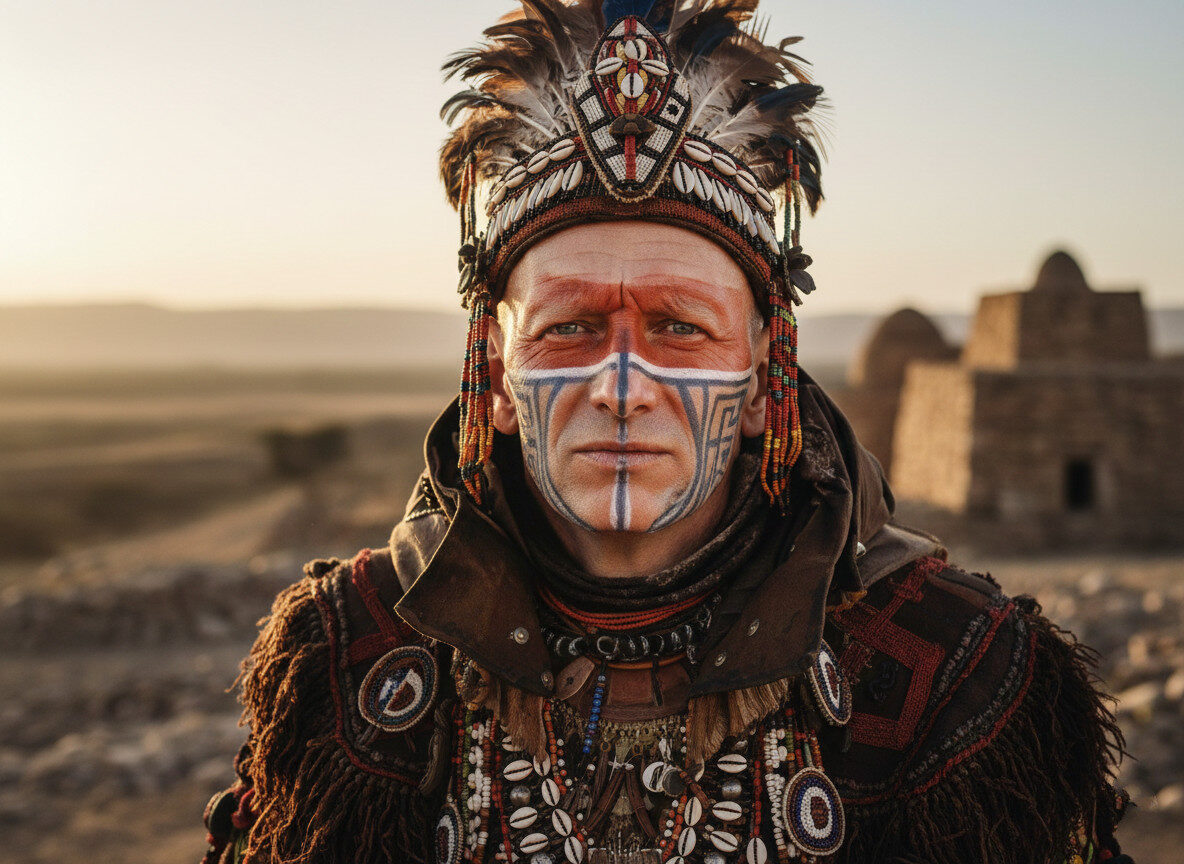
Jimmy Nelson was born in 1967 in Sevenoaks, England, though his childhood was anything but conventional. His father worked as a geologist for International Shell, so Nelson grew up between Africa, Asia, and South America, moving constantly and absorbing cultures most people only read about in books.
At seven years old, he was sent to Stonyhurst College, a Jesuit boarding school in Lancashire, a sharp contrast to the itinerant life he’d known. It was at seventeen, when he fled the boarding school and trekked to Tibet, that he first picked up a camera seriously. Photography became his way of making sense of the world, of capturing what felt permanent in a life defined by motion. After Tibet, he began working professionally, commissioned to cover culturally and politically charged stories from the Russian involvement in Afghanistan and conflict in Kashmir to the war in the former Yugoslavia.
But Nelson’s trajectory shifted in 2010 when he began a project that would consume the next decades of his life. He set out to document indigenous peoples before, as he saw it, globalization erased their traditions entirely. He traveled to Siberia, Papua New Guinea, Mongolia, Namibia, and dozens of other locations, often trekking for days to reach communities that still lived according to ancient customs. The resulting work, published in his 2013 book Before They Pass Away, presented these cultures in heroic, almost mythic portraits. Faces painted for ceremony, bodies adorned with feathers and beads, landscapes vast and unforgiving.
The images were stunning. They were also controversial. Critics questioned whether Nelson’s romantic vision served the communities he photographed or simply fed Western nostalgia for a vanishing “primitive” world. Nelson listened. His later projects became more collaborative, inviting indigenous voices into the conversation and addressing issues like climate change and cultural preservation with greater nuance.
His strengths: Technical mastery of large format photography, including a 50-year-old 4x5in camera used for Before They Pass Away, an ability to gain trust in isolated communities, compositional grandeur that elevates his subjects, and a willingness to evolve his approach in response to criticism.
Career highlights: Before They Pass Away exhibited globally and published in multiple language editions, partnerships with indigenous rights organizations, and ongoing documentation projects that balance aesthetic beauty with ethical responsibility.



Leave a Reply