
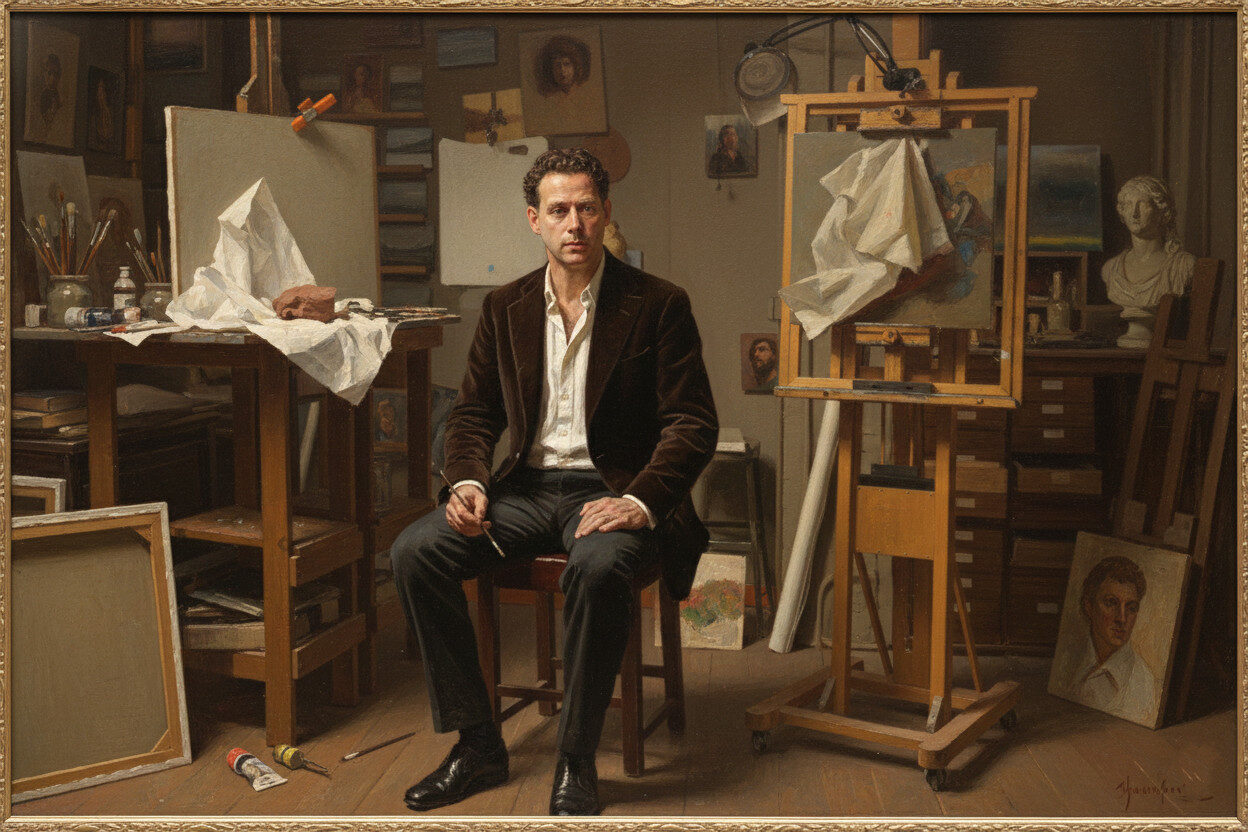
Jacob Collins was born in 1964 in New York City into a family steeped in art and scholarship. As a child, he began copying Old Master paintings at the Metropolitan Museum of Art under the guidance of his grandmother, Alma Schapiro, herself a Paris-trained artist. His great-uncle was Meyer Schapiro, a renowned professor of art history at Columbia. Even then, Collins knew he wanted to be a painter, though the classical style he loved had long fallen out of fashion.
At eighteen, he enrolled at Columbia University to study history rather than art, having accepted what seemed like common wisdom at the time: that anyone who truly knew how to draw and paint had disappeared after 1913. But Collins couldn’t stay away from painting. After graduating from The Dalton School, he studied at the New York Studio School, earned his BA in history from Columbia, then attended the New York Academy of Art and the Art Students League. He also spent time copying masterworks at the Louvre, the Prado, and the Uffizi, absorbing techniques that contemporary art schools no longer taught.
When Collins returned to his New York studio, something unexpected happened. Other painters, equally dissatisfied with modernism’s dismissal of craft, began gathering around him. In the early 1990s, he formalized these informal study sessions by founding the Water Street Atelier in a Brooklyn loft. The atelier operated on old principles: students drew from plaster casts, studied anatomy, learned to mix colors properly, and progressed slowly from grisaille painting to full figure work. It was demanding, and it worked.
In 2006, Collins founded the Grand Central Academy of Art, developing a more structured three-year curriculum built around the methods taught in fifteenth through nineteenth century ateliers. In 2014, he opened his largest facility yet: a converted warehouse in Long Island City that serves as both school and community for dozens of painters trained in his program. The atelier movement he helped launch has spread across the country, proving that interest in classical training never truly disappeared. It just needed somewhere to go.
Collins himself continues to paint with quiet intensity. His still lifes arrange pomegranates and flour packages into compositions that glow with inner light. His landscapes capture the Hudson Valley without sentimentality. His portraits and nudes are rendered with anatomical precision but feel unmistakably contemporary in their simplicity. There is nothing ironic in his work, no winking acknowledgment of the postmodern moment he has chosen to ignore.
His strengths: Exceptional draftsmanship developed through years of museum copying, nuanced control of light and tone, dedication to reviving rigorous teaching methods, and unwavering commitment to representational painting in an era that long dismissed it.
Career highlights: Founding the Water Street Atelier and Grand Central Academy of Art, training generations of classical realist painters, and creating a body of work that demonstrates beauty and technical mastery remain vital concerns for contemporary art.






Leave a Reply