
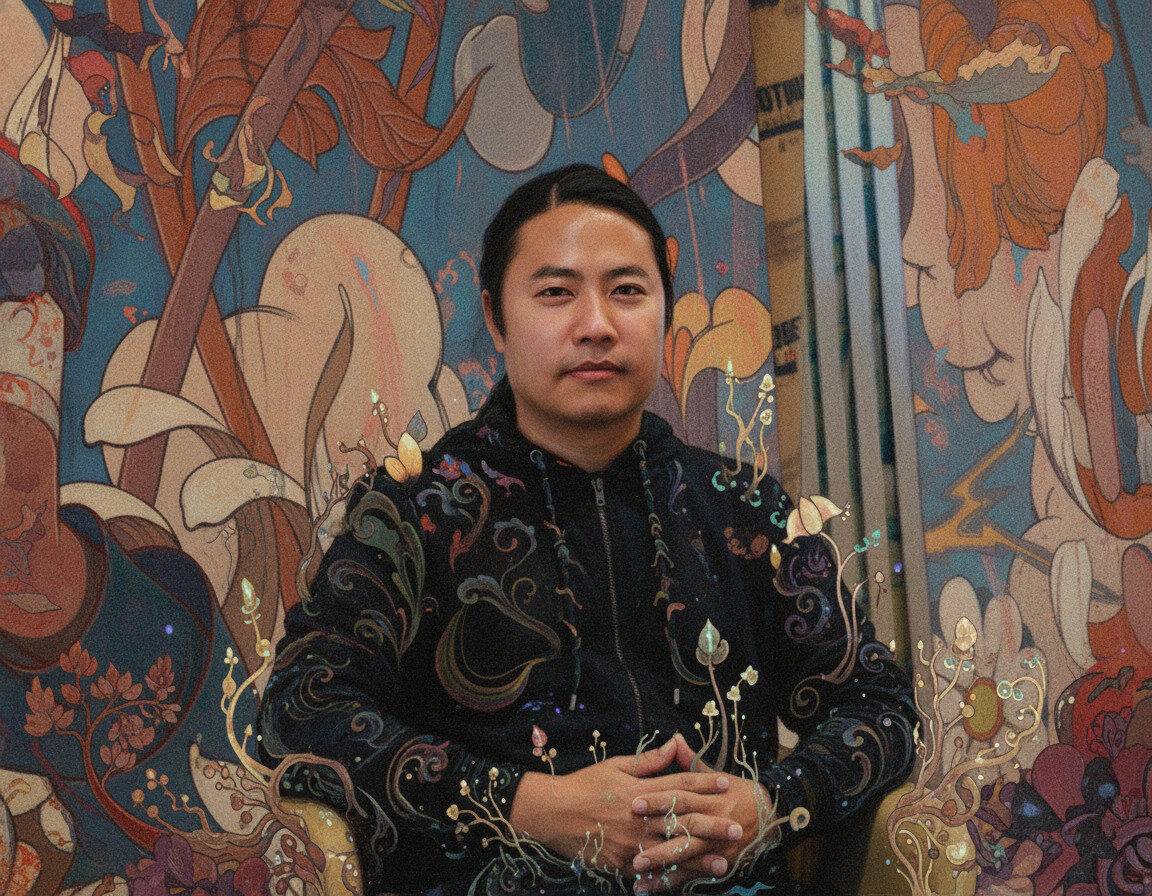
James Jean was born in 1979 in Taipei, Taiwan. His family moved to Parsippany, New Jersey when he was three years old, where he grew up between two worlds. As a child, he explored music first, learning piano and trumpet, spending hours practicing scales and melodies. But his hands always wandered back to drawing. Faces in the margins of notebooks. Bodies twisting across homework pages. Abstract patterns that seemed to come from somewhere outside himself.
He studied at the School of Visual Arts in New York City, graduating in 2001 with an illustration degree. Upon graduating, he quickly became a cover artist for DC Comics, specifically for Fables, a modern fairy tale series published under the Vertigo imprint. His covers were different. Intricate, dreamlike, with a fluidity that felt more like classical painting than comic book art.
The awards started piling up. Seven Eisner Awards. Three consecutive Harvey Awards. Gold medals from both the Society of Illustrators of Los Angeles and New York. In 2005, he won the Wizard Fan Award for Favorite Cover Artist. In 2006, the World Fantasy Award for Best Artist.
He moved to Los Angeles in 2003, trading New York’s chaos for California light. The commercial work expanded. Time Magazine, The New York Times, Rolling Stone, ESPN. Album covers for My Chemical Romance’s The Black Parade in 2006, work for Linkin Park. Installations and textiles for Prada starting in 2007. In 2008, his anti-AIDS campaign for the French organization AIDES won a Bronze Lion at the Cannes Advertising Festival.
But something was shifting. Jean was becoming one of the most sought-after commercial illustrators in the world, and it was killing something inside him. In 2008, he walked away entirely. No more commercial work. No more comic covers. He wanted to paint for himself, to see what would emerge if he stopped serving other people’s visions.
His fine art exploded with the same intricate detail as his commercial work but freed from narrative constraints. He fused Chinese scroll painting techniques with Japanese woodblock prints and Renaissance portraiture. Single figures engaged in everyday tasks. Massive cosmological worlds layered with mythology and contemporary culture. His small-scale pieces felt intimate, focused on specific emotions. His large-scale works recalled Hieronymus Bosch, sprawling with impossible detail.
In 2016, Takashi Murakami curated Juxtapoz x Superflat at the Vancouver Art Gallery. Jean’s painting Bouquet served as the marquee image, placing him firmly within the Superflat movement alongside Murakami himself. In 2018, his exhibition Azimuth at Murakami’s Kaikai Kiki Gallery in Tokyo featured illuminated stained glass works made at Judson Studios. In 2019, the Lotte Museum of Art in Seoul hosted Eternal Journey, a major retrospective. His work has been collected by museums worldwide. His prints sell out within minutes.
The New York Times compared his work to Maxfield Parrish. Guillermo del Toro commissioned him to create the poster for his Pinocchio film. His Instagram following numbers in the millions. But Jean still fills sketchbooks every year, the same habit he’s had since childhood, capturing visions before they disappear.
His strengths: Intricate linework that borders on obsessive, ability to fuse Eastern and Western aesthetic traditions seamlessly, dreamlike quality that makes viewers question what they’re seeing, and courage to walk away from commercial success to chase something more elusive.
Career highlights: Seven Eisner Awards, three Harvey Awards, World Fantasy Award for Best Artist, Cannes Bronze Lion, major retrospective at Lotte Museum of Art, representation by Takashi Murakami, poster work for Guillermo del Toro’s Pinocchio, and a successful transition from commercial illustration to internationally recognized fine artist.
Leave a Reply