
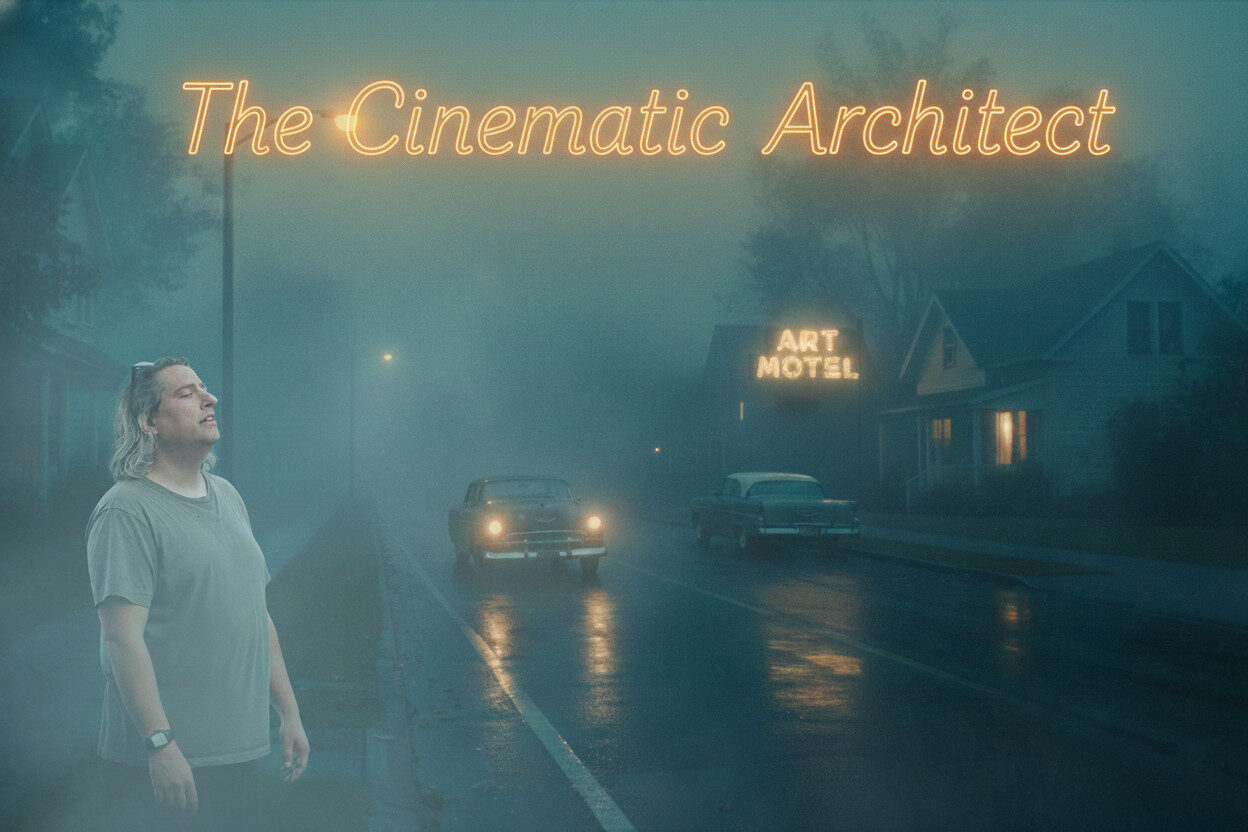
Gregory Crewdson was born on September 26, 1962 in Park Slope, Brooklyn. His father was a psychoanalyst who saw patients in their Park Slope home. As a child, Crewdson would lie in bed listening to muffled voices through the walls, imagining what stories were unfolding in his father’s office. He learned early that the most fascinating narratives happen behind closed doors in ordinary houses.
At ten years old, his family took him to see the Diane Arbus retrospective at the Museum of Modern Art. The photographs disturbed him. They also showed him that a camera could reveal things about people they didn’t know they were showing. As a teenager, he played in a punk band called The Speedies. Their single “Let Me Take Your Photo” became prophetic. In 2005, Hewlett Packard would use it in commercials for digital cameras.
He studied photography at SUNY Purchase in the mid-1980s, working with photographers Jan Groover and Laurie Simmons. Then Yale for his MFA in 1988. After graduating, he started Natural Wonder, his first major series. The images were black and white, depicting flowers, insects, and suburban landscapes with an underlying sense of menace. Something grotesque lurking beneath beauty.
But Crewdson wanted more. He wanted to create photographs that felt like movies. In 1998, he began Twilight, a series shot during the magic hour just after sunset. He hired production crews. Lighting technicians. Set designers. He blocked streets in small Massachusetts towns and transformed them into stages. A woman stands in her flooded living room. A man lies on his front lawn while neighbors watch. Each image suggested a narrative but refused to explain it.
Beneath the Roses, which took nearly a decade to complete from 2003 to 2008, employed crews of over a hundred people. The scale was cinematic. He used Hollywood lighting equipment, cranes, generators powerful enough to illuminate entire neighborhoods. Each photograph cost tens of thousands of dollars to produce. He was directing still images the way Spielberg or Lynch might direct a feature film. The influence was obvious. He cited Close Encounters of the Third Kind, Blue Velvet, Vertigo, and The Night of the Hunter as inspiration, along with Edward Hopper’s paintings of American isolation.
His only work made outside the United States was Sanctuary in 2009, shot at the legendary Cinecittà studios in Rome. Nearly everything else has been photographed in the small towns of Western Massachusetts, where he’s lived since 2011 in a converted Methodist church with his partner Juliane Hiam, a writer and producer who appears in many of his photographs.
Cathedral of the Pines from 2013 to 2014 took him into the forests of Becket, Massachusetts, where he spent childhood summers. The series felt more intimate, focused on solitary figures in nature rather than suburban tableaus. An Eclipse of Moths followed in 2018 to 2019, then Eveningside from 2021 to 2022, continuing his exploration of American loneliness rendered with meticulous beauty.
Crewdson is an open-water swimmer. He’s said the meditative state he achieves during his daily swimming practice is fundamental to his creative process. There’s something about the repetition, the cold shock, the surrender to water that connects to how he makes photographs. Both require patience. Both demand you trust something larger than yourself.
In 2012, the documentary Gregory Crewdson: Brief Encounters followed him through the grueling process of creating Beneath the Roses. The film showed what his finished photographs hide: the months of location scouting, the casting, the technical nightmares, the pressure, the obsessive attention to details nobody would notice. Making a single Crewdson photograph looks exhausting. Making dozens looks impossible.
Since 1993, he’s directed graduate studies in photography at Yale, teaching the next generation while continuing to push his own practice into stranger, more ambitious territory. His work hangs in MoMA, The Met, the Whitney, LACMA, SFMOMA, and institutions across Europe. He’s received the Skowhegan Medal for Photography, NEA fellowships, countless honors.
His strengths: Unparalleled ability to stage and light cinematic tableaus, patience to spend years completing single series, vision that makes suburban America feel both familiar and deeply strange, courage to work at scales most photographers would consider insane.
Career highlights: Beneath the Roses employing crews of over 100 people, Sanctuary at Cinecittà studios, Cathedral of the Pines at Gagosian, Brief Encounters documentary, three decades directing graduate studies at Yale, permanent collections at major museums worldwide.
Leave a Reply