


The train derailed outside Leipzig on a spring day in 1960. 🚂 Hanno Rauch, twenty-one, and Helga Wand, nineteen, both art students at the city’s academy, died together four weeks after their son was born. They never gave a reason for the name they’d chosen. Neo. New.
The baby went to his maternal grandparents in Aschersleben, an industrial town where the smokestacks never stopped and the state told you what to think. 🏭 His grandparents hung photographs of his dead parents throughout the house. Their paintings too. The boy grew up surrounded by ghosts he’d never met, studying the brushwork of people who’d barely learned to hold him.
He was twelve when the Berlin Wall went up. By then he’d already decided: he would attend the exact same academy where his parents had studied, learn from the same professors, walk the same halls. 🎓 As if retracing their steps might explain why they’d left him behind.
The academy in Leipzig taught Socialist Realism: workers with noble faces, heroic industry, the triumph of the collective. Neo mastered it. 🎯 He learned to paint like his dead father might have painted, if his father had lived long enough to become good. For years he produced what the state demanded: propaganda murals, ideologically correct compositions. He was skilled. He was successful. He was quietly suffocating.
Then came 1989. 🧱 He was twenty-nine when the Wall fell, when everything he’d been trained to paint became instantly obsolete. 💥 The professors who’d taught him disbanded. The aesthetic he’d mastered turned into a punchline. East Germany collapsed like a stage set.
Most artists would have been destroyed by this. Neo was liberated. ✨
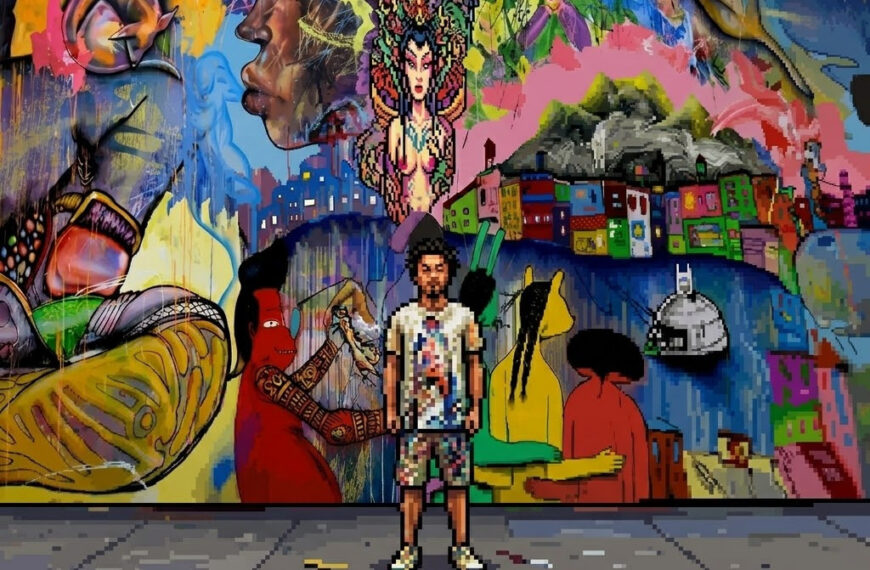
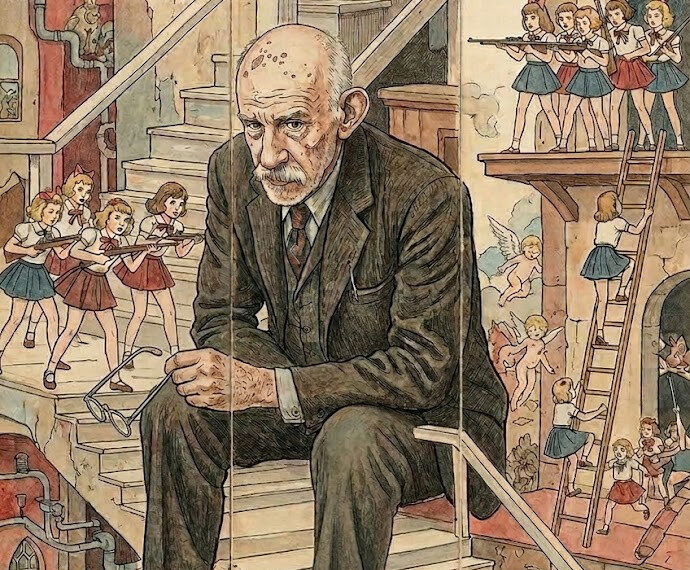
He began painting the strangest canvases Germany had seen in decades. 🎨 Enormous works where workers in vintage uniforms stood beside men in modern dress. Where industrial landscapes melted into fever dreams. Where comic book aesthetics collided with memories of propaganda posters. His figures existed in temporal distortions, citizens of no particular era, caught in scenes that suggested narrative but refused to explain themselves. 🌀
The paintings looked like memories half-recalled from someone else’s life. Which, in a way, they were. 💭
He met Rosa Loy at the academy, another painter navigating the wreckage of the former GDR. They married in 1985, when the Wall still stood and the future looked nothing like what it became. 💕 After reunification, they moved into an old cotton mill on Leipzig’s outskirts. Separate studios, connected by a single door. They opened it for lunch and coffee. The rest of the time, they worked alone.
Neo painted obsessively. His canvases grew larger, more enigmatic, more technically virtuosic. The art world noticed. 🌟 By 2002, he’d won the Vincent Award. By 2007, the Metropolitan Museum in New York gave him a solo show. His paintings sold for over a million dollars. He became what critics called “the greatest living German painter,” a title that felt both absurd and inevitable for an orphan who’d learned to paint from photographs of the dead.
Today, at sixty-four, he still works in that converted cotton mill. Rosa in her studio, Neo in his, the door between them opening and closing like a metronome. 🏭 He drives a blue Porsche 911 because he likes how it refuses to look aggressive, how its form resists distortion. On summer mornings he visits the foundation he established in Aschersleben, the town where he grew up studying his parents’ faces in picture frames.
His paintings hang in museums across the world now. 🖼️ Enormous canvases filled with figures who seem to be remembering something they never experienced. Workers who might be soldiers. Landscapes that might be dreams. Scenes that feel simultaneously like propaganda and its opposite, like memory and its corruption, like East Germany and everywhere else, like past and future colliding in an eternal, unresolvable present.
People ask what the paintings mean. Neo just smiles. 😊 He’s spent his entire life trying to understand the inexplicable: why a train derailed, why his parents died, why he was left behind with their unfinished work. The paintings don’t answer these questions. They just make the asking beautiful.
In the studio next door, Rosa works on her own canvases, women in mysterious rituals, delicate and unsettling. ☕ At noon, the door opens. They eat lunch together in the space between their separate worlds, two people who survived the collapse of everything they knew and learned to make art from the rubble.
Then the door closes again, and Neo returns to his ghosts. 🖌️ He picks up his brush and continues the conversation his parents began in 1960, four weeks before a train took them away and left him to finish what they’d started.
Some people get to choose their obsessions. Neo inherited his. 🎭
Based on the true story of Neo Rauch
Leave a Reply