Visual Artist – Damien Hirst ⭐Exceptional
The Physical Impossibility of Death in the Mind of Someone Living (1991) Creativity 🟦+Impact🟪: 82%
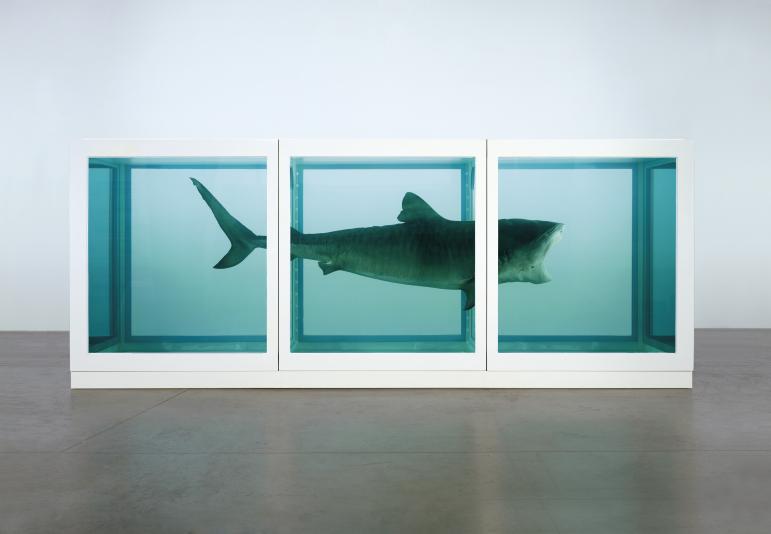
Damien Hirst’s The Physical Impossibility of Death in the Mind of Someone Living is a 14-foot tiger shark preserved in formaldehyde inside a steel and glass vitrine measuring 213 × 518 × 213 cm. Commissioned in 1991 by Charles Saatchi who offered to fund whatever Hirst wanted to create, the shark cost £6,000 and the total work £50,000. First exhibited in 1992 at the Saatchi Gallery, British tabloid The Sun ran a story titled “£50,000 for fish without chips”.
Here’s how this rating breaks down using the Consistent Multi-Criteria Rubric method:
Technical Skill and Execution (25% of total score): 7/10 = 1.75 points
Hirst outsourced all fabrication. The shark was caught to order, manufacturers built the vitrine, professionals handled preservation. Initial preservation failed and the shark deteriorated. In 2006, the entire specimen was replaced. Concept over craft.
Composition and Design (25% of total score): 9/10 = 2.25 points
The scale overwhelms deliberately. Clinical vitrine presentation creates museum authority while forcing direct confrontation with mortality. Perfect isolation of predator from element.
Originality and Creativity (20% of total score): 9/10 = 1.80 points
Became an iconic symbol of British art from the 1990s and Britart worldwide. When replaced, Hirst proved the idea mattered more than the materials. Revolutionary conceptual leap.
Color Use and Harmony (15% of total score): 6/10 = 0.90 points
Greenish formaldehyde and grey-white flesh create clinical unease, but color serves concept rather than being a primary aesthetic concern.
Emotional Impact and Expression (15% of total score): 10/10 = 1.50 points
The New York Times described it as “simultaneously life and death incarnate in a way you don’t quite grasp until you see it”. Maximum visceral impact. Simultaneously repulsive and mesmerizing, embodying the impossibility of comprehending death while alive.
Total: 82%
The high score reflects revolutionary conceptual vision and massive cultural impact despite limited personal technical craft. Sold to Steven Cohen in 2004 for a reported $8-12 million, proving conceptual art could command unprecedented prices while redefining what constitutes an artwork when the physical object becomes replaceable.