

Saul’s father didn’t speak to him for years after he left Pittsburgh.
- Saul was 23 years old, the son of a Talmudic scholar, and he’d just committed the ultimate betrayal: he’d abandoned his religious studies to become a painter. His father was devastated. This wasn’t what Orthodox Jewish boys did. 🎨
But Saul didn’t care. He packed his things, took a train to New York City, and enrolled at the Art Students League. He was going to be a painter. He rented a tiny room on the Lower East Side and started painting abstracts.
Then in 1948, a friend handed him a camera. Just to document his paintings, they said. 📷
Saul started walking the streets with it. Shooting whatever caught his eye. And something shifted. The camera felt right in a way the paintbrush never quite had.
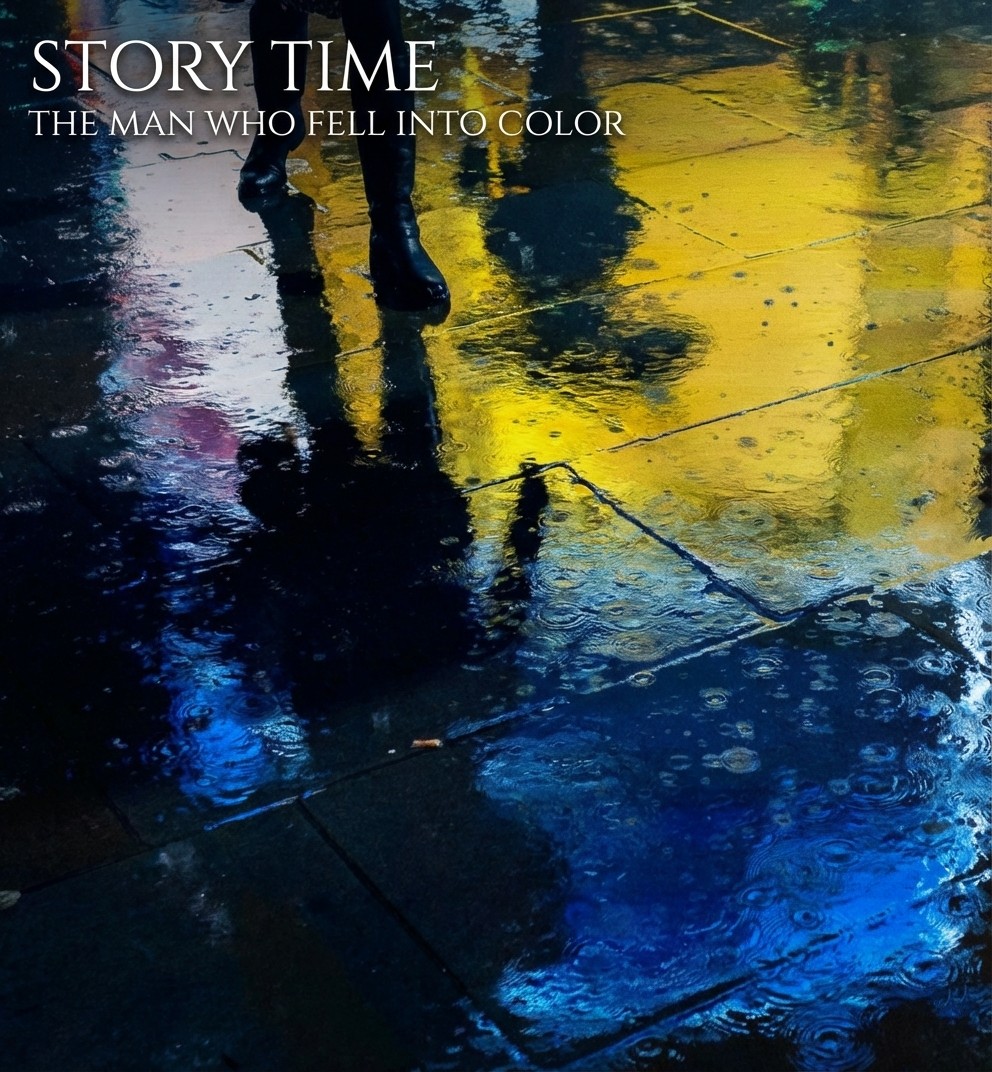
He kept shooting. Kept walking. The East Village. Midtown. Rain-soaked streets and reflections in windows.
And then he made a decision that would get him laughed out of every serious gallery for the next 50 years: he started shooting in color. 🌈
Here’s the problem. In the late 1940s, color photography wasn’t art. It was advertising. It was snapshots from family vacations. It was what serious photographers avoided because “real” photography was black and white. Ansel Adams. Henri Cartier-Bresson. Robert Frank. All black and white. All the time.
The Museum of Modern Art wouldn’t touch color. Critics dismissed it as vulgar. Commercial. Beneath consideration. 🚫
Saul didn’t care. He walked the streets with his Leica, hunting color the way other photographers hunted decisive moments. He shot New York like it was an abstract painting in motion: a yellow taxi against a blue wall, a red umbrella in the rain, green awnings and orange traffic lights creating accidental compositions. 🚕
He developed his prints using dye-transfer, an insanely complex process used mainly for advertising that gave him total control over color saturation. His prints were LOUD. Saturated. Vibrant. Gorgeous.
Nobody wanted them. 😔
So Saul did what he had to do: he got a job. In 1957, Henry Wolf at Esquire magazine started hiring him for fashion work. When Wolf moved to Harper’s Bazaar in 1958, Saul followed. For nearly 20 years, he shot fashion photography: beautiful work, good money, steady assignments. 💼
But his personal work, the color street photography he shot on his own time? Galleries said no. Museums said no. His photographer friends thought he was wasting his talent on gimmicks.
For decades, Saul Leiter kept shooting. Kept printing. Kept stacking the work in his tiny rent-controlled apartment on East 10th Street. Mountains of slides. Boxes of prints. Most of it never shown to anyone. 📦
In 1954, he married a woman named Barbara Hatch. By 1959, they’d separated. After that, he began a relationship with Soames Bantry, a painter and writer. They stayed together for over 40 years, living in that same cramped apartment, surrounded by Saul’s photographs and paintings. 💕
The 1970s came. Color photography started gaining respect. William Eggleston got a show at MoMA in 1976. Stephen Shore was making waves. Suddenly color wasn’t just for advertising anymore. 🔄
But by then, Saul had mostly stopped caring about recognition. He was in his 50s, then his 60s. He kept shooting because he couldn’t not shoot. He painted. He taught occasionally. He lived quietly with Soames.
The art world had moved on without him. Or so it seemed. ⏳
Then in 2006, something unexpected happened. Howard Greenberg Gallery in New York put together a book of Saul’s early color work. He was 83 years old. 📚
And the photography world lost its mind. 🌟
Who was this? How had they never heard of him? The composition, the use of color, the way he saw the ordinary street as extraordinary: this was masterwork. This was a pioneer who’d been shooting groundbreaking color photography since the 1940s, decades before it became acceptable.
Suddenly everyone wanted to show Saul Leiter. Museum retrospectives. Gallery exhibitions in New York, London, Paris. Books. A documentary. The same art world that had ignored him for 50 years was calling him a visionary, a master, one of the great pioneers of color photography.
Saul was bemused by all of it. 😊
In interviews, he was soft-spoken, gentle, almost shy about his work. He’d make tea, shuffle around his cluttered apartment in his cardigan, and quietly deflect praise.
“I spent a great deal of my life being ignored,” he said. “I was always very happy that way.”
He kept living in that same rent-controlled apartment on East 10th Street. The same place he’d lived since 1952. The walls were covered with his paintings. Boxes and boxes of photographs were stacked everywhere: thousands of images, many never even printed, some never even developed. 📸
Soames had died in 2002. Saul lived alone now, still shooting occasionally, still painting, surrounded by a lifetime of work.
When he died in 2013 at age 89, archivists were still discovering unknown photographs in his apartment. Slides from the 1950s that had never been shown. Prints stuffed in closets. Decades of genius that almost nobody had ever seen. 🕊️
Today, Saul Leiter is recognized as one of the pioneers of color photography. His prints sell for tens of thousands of dollars. Major museums exhibit his work worldwide. Photography students study his compositions, his use of reflections, his mastery of color. 🎓
The man the art world ignored for 50 years became one of the most influential photographers of the 20th century.
All because he looked at a rainy street in New York and saw color when everyone else only saw in black and white. 🌧️
Based on the true story of Saul Leiter (1923-2013)
Leave a Reply