
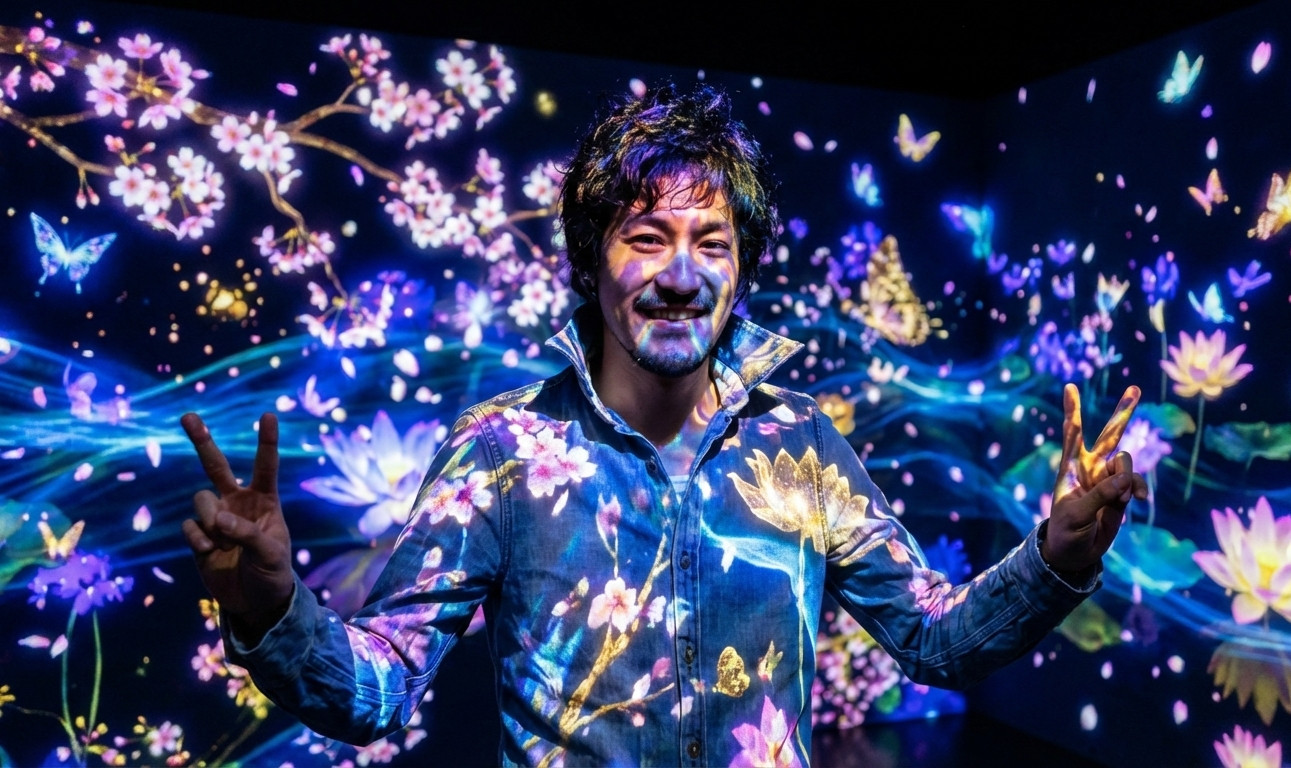
TeamLab was founded in 2001 by Toshiyuki Inoko and four friends from the University of Tokyo. Inoko was born in 1977 in Tokushima, Japan, and studied Mathematical Engineering and Information Physics. The founding members included Shunsuke Aoki, Sakai Daisuke, Tamura Tetsuya, and Yoshimura Joe, all with engineering backgrounds. They officially incorporated when Inoko graduated in March 2001.
In the beginning, the art world didn’t recognize them. They survived creating commercial software, websites, and office designs for corporations while pursuing artistic experiments. In 2011, Takashi Murakami invited them to display work at his Kaikai Kiki Gallery in Taipei. Recognition spread. In 2014, Pace Gallery in New York started representing them. The collective now comprises over 400 members, artists, programmers, engineers, CG animators, mathematicians, architects, botanists. They call themselves “ultra-technologists.”
In June 2018, they opened MORI Building DIGITAL ART MUSEUM: teamLab Borderless in Odaiba, Tokyo. The museum operated on the concept of a world without boundaries, where approximately 50 artworks move freely between rooms, influence each other, and create seamless experiences. Visitors received no map. They wandered through projected environments where butterflies migrated from room to room and flowers bloomed based on human touch. In its first year, Borderless welcomed 2.3 million visitors from over 160 countries, becoming the most visited single-artist museum in the world.
One month later, they opened teamLab Planets in Toyosu, Tokyo. Visitors walk barefoot through water, physically immersing their bodies in massive artworks. The exhibition welcomed over 1.25 million visitors in its first year and has been extended until the end of 2027. In 2019, they opened teamLab Borderless Shanghai. The original Borderless in Odaiba closed in 2022 for redevelopment and reopened in February 2024 at Azabudai Hills in a new, larger space. Their work entered permanent collections at the National Gallery of Victoria, Museum of Contemporary Art Los Angeles, and Asian Art Museum San Francisco.
Their philosophy rejects Renaissance one-point perspective. Instead, they draw from pre-modern Japanese scroll paintings that combined multiple perspectives. Digital technology allows them to create what Inoko calls “ultra-subjective space,” where borders between viewer and artwork become ambiguous. Visitors don’t observe art. They become part of it.
Their strengths: pioneering use of interactive digital technology in immersive environments, ability to attract unprecedented visitor numbers, successful fusion of art, technology, and nature, collaborative creation involving hundreds of specialists, philosophical rigor investigating perception through technology.
Career highlights: Borderless becoming the world’s most visited single-artist museum, Planets attracting over 1.25 million visitors, permanent installations across six continents, Pace Gallery representation since 2014, work in permanent collections at major museums worldwide.










Leave a Reply