
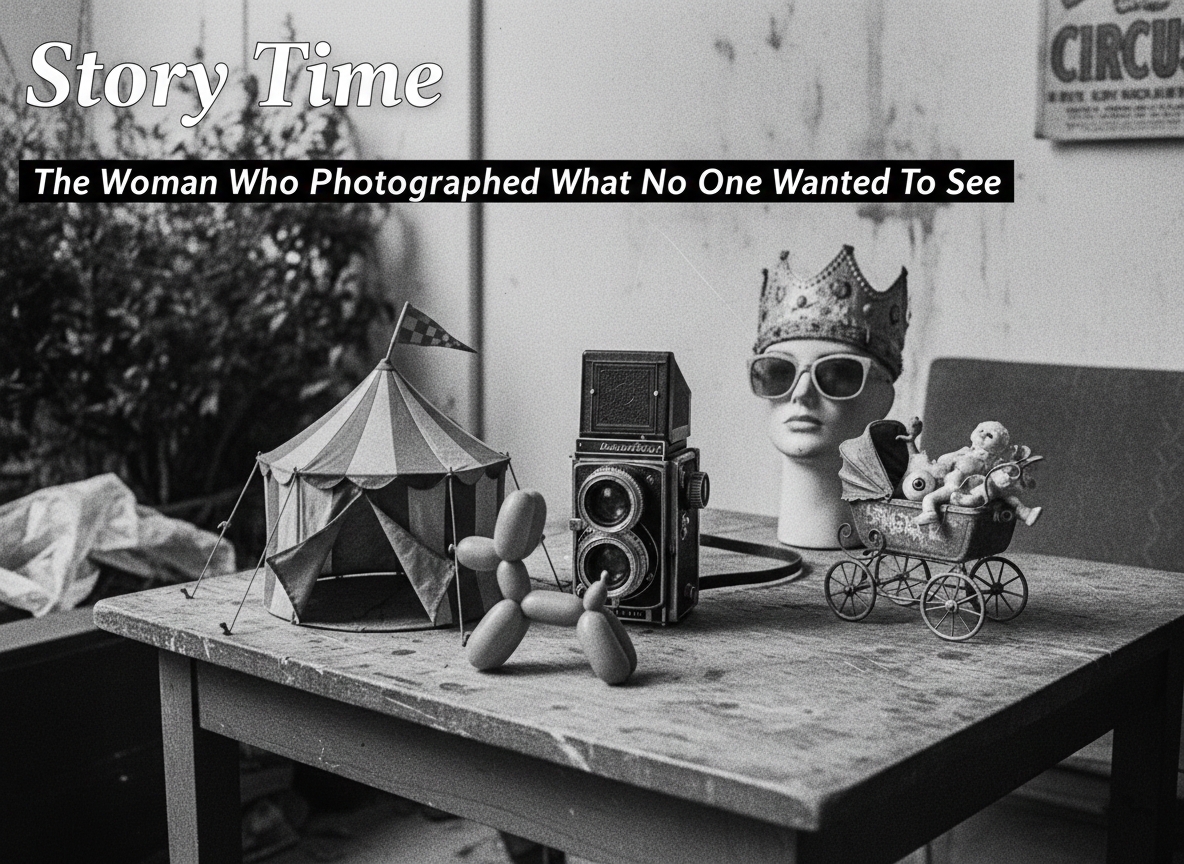

Diane sat in the darkroom at Russek’s department store, watching her husband Allan develop another fashion photograph.
It was 1946. She was 23 years old, married at 18, and this was her life now. The commercial photography business “Diane & Allan Arbus.” He took the pictures. She styled the models for Vogue and Harper’s Bazaar. 👗
Perfect. That word followed her everywhere. Perfect department store upbringing. Perfect Fifth Avenue childhood. Perfect fashion photographs that made everything look beautiful and clean.
She hated it. 😔
Diane had grown up wealthy in Manhattan, daughter of parents who owned Russek’s department store. While the Depression destroyed families around her, she’d been completely insulated. And she felt trapped in a world where everything looked fine on the surface. 🏢
By 1956, she’d had enough. She stopped working with Allan. Started taking classes with photographer Lisette Model. And began walking the streets of New York with her camera. 📷
But Diane didn’t photograph what other people photographed.
She went to Times Square sideshow museums. To gay nightclubs. To Coney Island. She sought out dwarfs, giants, circus performers, transgender people, nudists. The people everyone else looked away from. 🎪
She called them “freaks,” but not with cruelty. She said: “Freaks were born with their trauma. They’ve already passed their test in life. They’re aristocrats.” 👑
Her technique was confrontational. She used a Rolleiflex camera that produced square images. She’d approach strangers directly and ask to photograph them. Flash pointed right at their faces. They’d stare directly back at the lens.
The results were unsettling. Intimate. Raw. 🔍
In 1967, the Museum of Modern Art included her in their landmark “New Documents” exhibition.
The show made her famous. And made everything worse. 📰
Some people saw her work as compassionate. Others saw it as exploitative, grotesque. After Norman Mailer saw his own portrait, he said: “Giving a camera to Diane Arbus is like putting a live grenade in the hands of a child.” 💣
Publishers became nervous. The public labeled her “the freak photographer.” The notoriety became a trap.
She’d divorced Allan in 1969. Lived alone in Westbeth Artists Community. Suffered from depression like her mother. The expectations felt crushing. 😞
On July 26, 1971, Diane Arbus died by suicide in her apartment. She was 48 years old. 🕊️
A year after her death, everything changed. ✨
In 1972, she became the first photographer ever included in the Venice Biennale. MoMA held a major retrospective that became the highest attended exhibition in the museum’s history to that point. The book “Diane Arbus: An Aperture Monograph” has never been out of print since 1972. 🖼️
Today, her photographs sell for hundreds of thousands of dollars. Major museums hold her work. The Met received her complete archives in 2007. 💰
Based on the true story of Diane Arbus (1923-1971)
Leave a Reply