
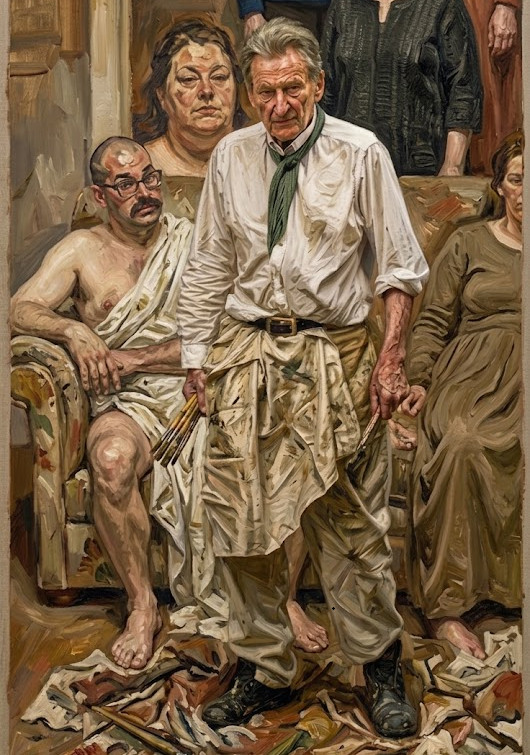
Lucian Freud was born on December 8, 1922, in Berlin, into a family that carried a famous name and the weight that came with it. His grandfather was Sigmund Freud, his father an architect, his mother a woman who had studied art history. When Hitler came to power in 1933, the family left for London, and Lucian would spend the rest of his life there, drinking in Soho clubs, betting on horses, and painting in the same studio on Kensington Church Street for nearly four decades.

He studied briefly at the Central School of Arts and Crafts in London and then at the East Anglian School of Painting and Drawing in Dedham under Cedric Morris, where something in his approach began to take shape. He committed himself to painting full time after the war, and by 1951 he had won the Arts Council prize at the Festival of Britain for Interior at Paddington. Three years later he represented Great Britain at the Venice Biennale alongside Francis Bacon and Ben Nicholson. He was in his early thirties and already building one of the most uncompromising bodies of work in postwar British art.
What Freud did over the next sixty years was quietly radical. At a time when abstract painting dominated the conversation, he kept his eyes on people, specifically the people in his life: friends, family members, lovers, children, and increasingly strangers who became something more than strangers through the long, punishing sessions he required of them. Tate has described his work as filling canvases with bodies rarely given space elsewhere: fat bodies, ageing bodies, queer bodies, exhausted bodies. He once called himself “a sort of biologist”, interested in the insides and undersides of things, and that description fits better than most.

His technique evolved slowly and deliberately. In the early work, the brushwork is tight and almost hyper-real. By the late 1950s, switching to stiffer hog-hair brushes, he moved toward a thicker impasto that built flesh up on the canvas in a way that felt almost sculptural. He cleaned his brush after every single stroke when painting skin, so the colour stayed constantly variable. He never painted from photographs. He never mixed natural and artificial light. He stood while painting for most of his career, only switching to a high chair in old age. These were not affectations; they were the result of someone who had thought very carefully about what it meant to be honest in front of a subject.
His work entered the collections of the Tate, the Metropolitan Museum of Art, the National Gallery, and the National Portrait Gallery, among many others. He was shortlisted for the Turner Prize in 1989 and was appointed to the Order of Merit in 1993. He died in London on July 20, 2011, and is buried at Highgate Cemetery. His final work, a portrait of his studio assistant and friend David Dawson, was left unfinished on his easel.
Best Artworks
1995 · Oil on canvas
His most famous single work and a landmark in figurative painting. The subject is Sue Tilley, a Jobcentre supervisor Freud painted multiple times across the mid-1990s. When it sold at Christie’s in 2008 for $33.6 million, it set the world auction record for a work by a living artist at the time.
9.5 / 10
1951–1952 · Oil on canvas · Tate, London
A portrait of his first wife, Kitty Garman, seated with her dress pulled down to expose one breast, a bull terrier resting beside her. The quiet tension in this painting is extraordinary, somewhere between intimacy and discomfort, and it marks the shift in his style from tight early realism toward something much more psychologically dense.
9.0 / 10
Large Interior, W11 (after Watteau)
1981–1983 · Oil on canvas
Five figures set in a house in West London: ex-partner Suzy Boyt, her son Kai, his daughter Bella Freud, painter Celia Paul, and a child called Star lying on the floor, loosely referencing Watteau’s Pierrot Content. Each sitter posed separately and they all gathered only once for Freud to sketch the composition. It sold in 2022 for $86.27 million at Christie’s New York, making it the highest-valued Freud painting on the public market.
9.0 / 10
2000–2001 · Oil on canvas · Royal Collection Trust
The British press called it unflattering. The Royal Collection kept it anyway. Freud painted the Queen with the same unflinching honesty he applied to everyone else, which is exactly what makes it remarkable. Some art historians have noted that the Queen’s aging features bear a striking resemblance to Freud’s own, suggesting it may function as a kind of disguised self-portrait.
8.5 / 10
1993 · Oil on canvas
A self-portrait in which Freud stands naked except for his paint-crusted boots, holding a palette and painting knife, staring back at the viewer with a kind of defiant directness. Painted at 71, it was his first and only nude self-portrait, and one of the most honest depictions of an aging male body in the history of painting.
8.5 / 10
2000 · Oil on canvas · National Gallery of Australia
An unusual work in Freud’s output, referencing Cézanne’s L’Après-midi à Naples with his own cast of figures. Its distinctive irregular shape, two canvases grafted together, makes it immediately recognizable. The National Gallery of Australia acquired it for $7.4 million.
8.0 / 10
Certified Overall Score
Sixty years of painting the same thing, people, and never once repeating himself.
9.4 /10


Leave a Reply