Visual Artist – Raphael ✔Certified
The School of Athens (1509–1511) Skill Mastery 🟨+ Impact🟪: 99%
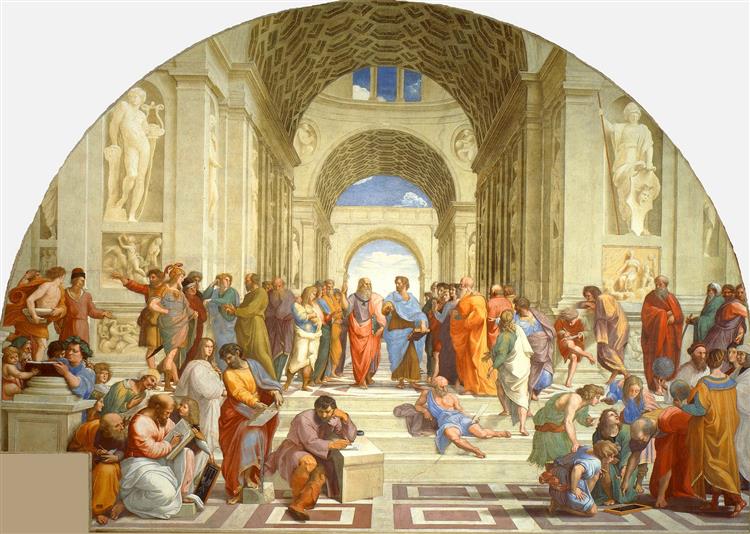
Raphael’s The School of Athens is a fresco measuring approximately 770 × 550 cm, painted on the wall of the Stanza della Segnatura in the Vatican Apostolic Palace. Executed when Raphael was between twenty-six and twenty-eight years old, the work depicts roughly fifty philosophers, mathematicians, and scientists of ancient Greece gathered beneath a vast barrel-vaulted hall whose architecture was modeled on Bramante’s designs for the new St. Peter’s Basilica. At the center stand Plato, gesturing upward toward ideal forms and given the face of Leonardo da Vinci, and Aristotle, gesturing downward toward the observable world. Heraclitus broods alone in the foreground with the face of Michelangelo, added after Raphael glimpsed the Sistine ceiling taking shape down the hall. Euclid demonstrates a geometric theorem with a compass on the lower right, wearing the face of Bramante. Raphael placed his own self-portrait at the far right edge, glancing quietly out at the viewer. The fresco has been called the supreme embodiment of Renaissance humanism and the most perfectly composed painting in Western art.
Composition Analysis: 99%
A 99% rating in composition looks like this: fifty figures organized across a receding marble floor so naturally that the eye moves from periphery to center and back without effort, and removing a single figure would unbalance the whole. Raphael’s central axis, formed by Plato and Aristotle framed beneath the deepest arch, anchors a composition that radiates outward in every direction without losing coherence. The vanishing point sits precisely between the two philosophers, pulling the entire painting into a single inevitable focal moment. Figures in the background remain fully readable as individuals despite existing fifty feet behind the picture plane. Each cluster of thinkers forms its own self-contained drama while contributing to the larger rhythm of the whole. The architectural barrel vaults do not merely frame the scene but create a procession of receding arches that gives the fresco its extraordinary sense of depth and grandeur. The entire composition operates on the principle of complex harmony made to feel simple. Every figure earns its place. The compositional mastery appears effortless, yet the painting required Raphael’s complete command of perspective, figure grouping, spatial recession, and pictorial rhetoric developed through years of absorbing Perugino’s geometric clarity, Leonardo’s psychological depth, and Michelangelo’s physical monumentality.
Summary: Fifty ancient thinkers gathered beneath monumental arches, composed with such precision that the arrangement of human bodies becomes an argument about the nature of knowledge itself.