
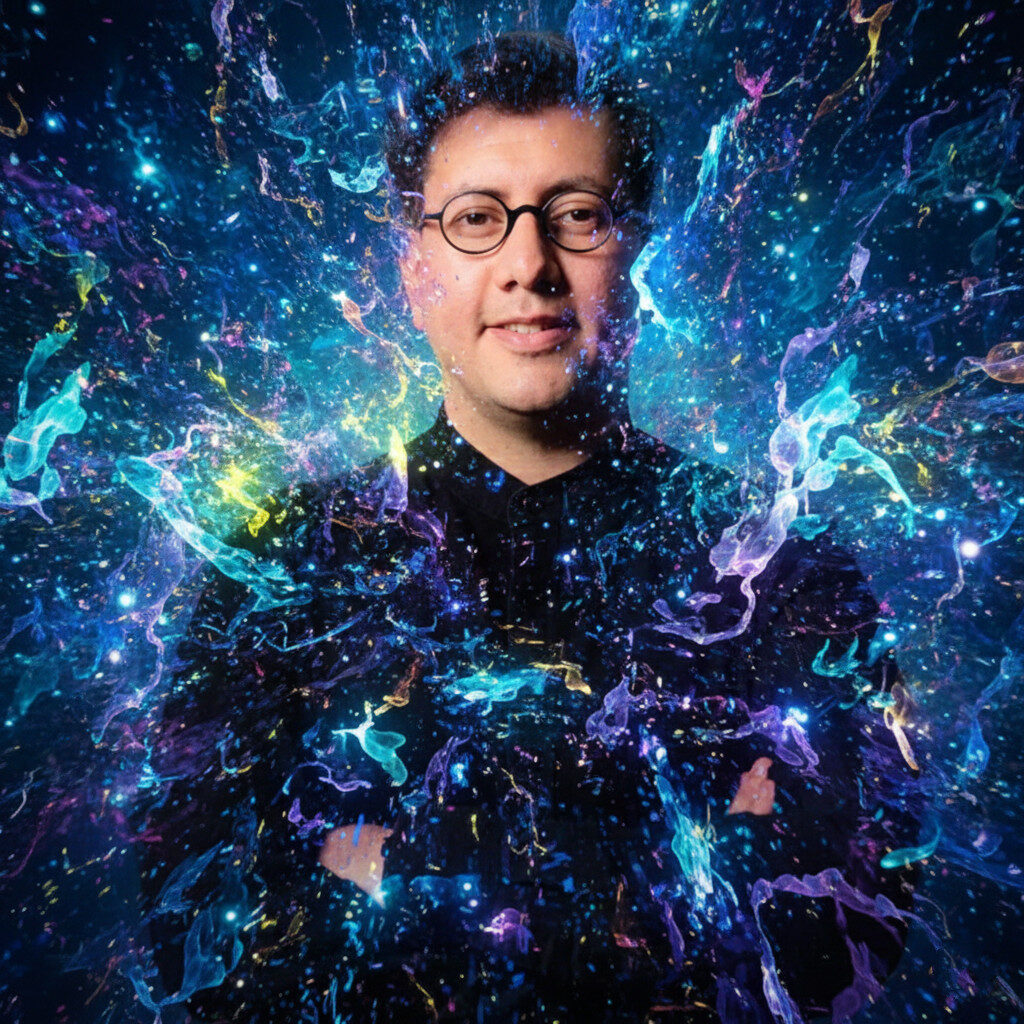
Refik Anadol was born in 1985 in Istanbul, Turkey. At eight years old, he taught himself to code on a Commodore 64. Computers spoke a language he understood instinctively.
He studied photography and video at Istanbul Bilgi University, graduating with highest honors in 2009, then earned his MFA in visual communication design in 2011. As an undergraduate, he read a paper by theorist Lev Manovich about augmented space. One sentence stopped him cold: collaborations between architects and artists could make “the invisible flow of data visible.” In 2008, he grabbed a projector and started beaming images onto concrete walls in Istanbul. Light became his material. Data became his pigment. He called it “data painting.”
In 2012, Anadol moved to Los Angeles for UCLA’s graduate program in design media arts. The next year, he pitched an impossible idea at Microsoft Research: use Walt Disney Concert Hall as a living canvas. Frank Gehry heard about it and said yes. For his 2014 thesis, Anadol created visualizations that listened to the Los Angeles Philharmonic and responded in real time. The building breathed with the orchestra.
The real breakthrough came in 2018. The LA Philharmonic commissioned him for their centennial. Anadol processed 45 terabytes of the orchestra’s hundred-year archive, fed it through machine learning algorithms, and projected it onto Disney Concert Hall’s exterior. The building dreamed its own history in cascading waves of color.
Since then, he’s transformed invisible information into experiences that feel impossible. He turned MoMA’s archive into swirling hallucinations. He visualized wind patterns across Berlin. He processed a hundred million coral images. His NFT collections raised millions for indigenous communities and climate causes.
His work asks uncomfortable questions. What happens when machines dream? Can data have beauty? What does memory look like filtered through artificial intelligence? Anadol answers with cathedral-scale visions that feel simultaneously ancient and alien.
In 2024, he announced Dataland, the world’s first museum dedicated entirely to AI art. Opening in 2026 next to Walt Disney Concert Hall, it will anchor Frank Gehry’s billion-dollar Grand LA development. The kid who learned to code at eight is building a temple for the digital age.
His strengths: Pioneer in making invisible data flows visible, technical mastery of machine learning and algorithmic art, ability to work at architectural scale, vision for transforming public spaces into living, responsive canvases.
Career highlights: WDCH Dreams at Walt Disney Concert Hall, Unsupervised at MoMA, founding Dataland museum, multiple international awards, raising over five million dollars for charitable causes through his work.






Leave a Reply