
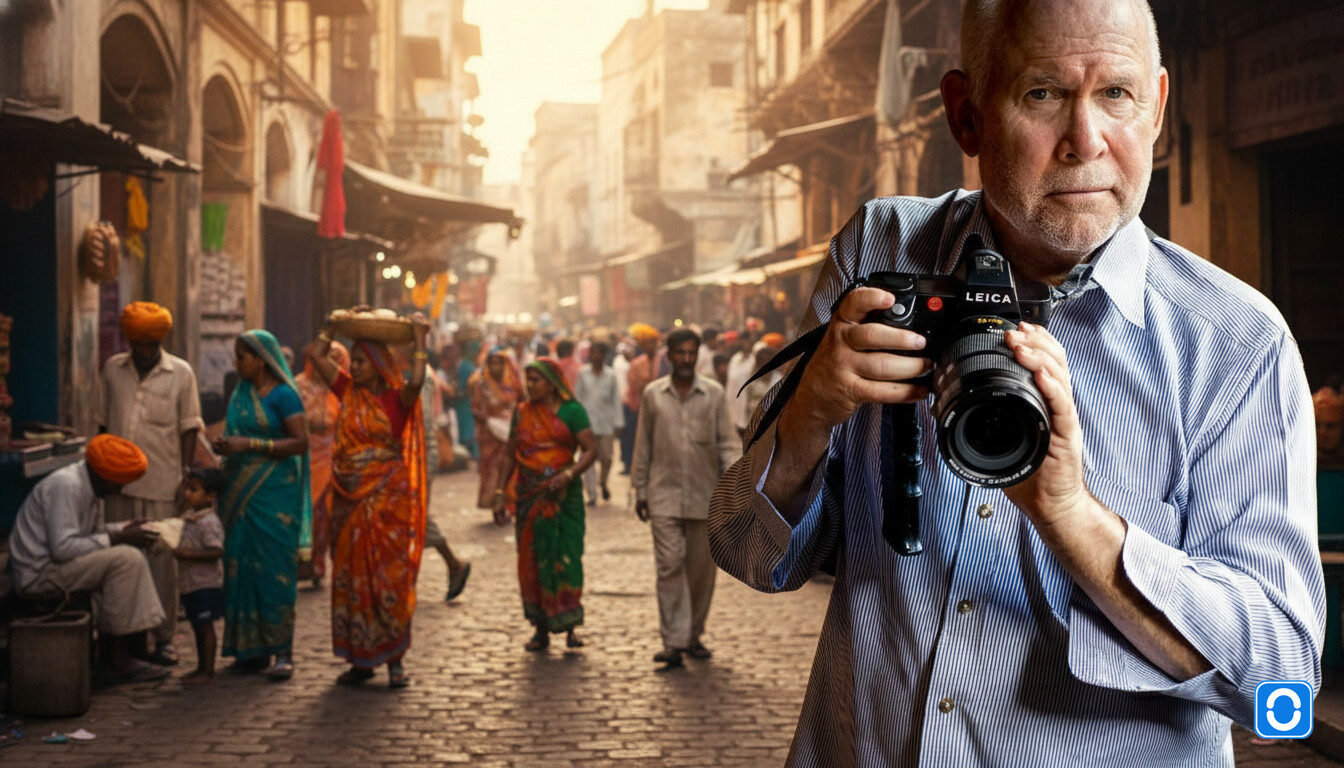
Steve McCurry was born in 1950 in Philadelphia, but his real life began the day he bought a one-way ticket to India.
He was twenty-eight years old. Fresh out of Pennsylvania State University with a theater degree and two years at a local newspaper behind him, he packed film and clothes into a bag and left. No plan, no assignment, no safety net. Just India spreading out before him like a fever dream. He wandered for months. Monsoons turned streets into rivers. Holy men emerged from clouds of incense. Color everywhere, overwhelming, intoxicating.
Then he crossed into Pakistan and heard the stories. Soviet tanks rolling into Afghanistan. Borders sealed. No Western journalists allowed. The refugees looked at him with a strange intensity. They could get him in.
McCurry made a choice that should have killed him. He let them disguise him in traditional Afghan clothing, grew out his beard, and crossed into a war zone with nothing but cameras and insane courage. For months, he lived with the Mujahideen fighters, sleeping in caves, hiking through mountain passes, documenting a conflict the world couldn’t see. Bullets and beauty. Death and prayers at sunset.
When he finally made it back to Pakistan, he had the story sewn into his clothes. Film rolls hidden in his socks, tucked into the lining of his jacket. Those photographs exploded across international media. He won the Robert Capa Gold Medal. He was thirty years old and already legendary.
But McCurry didn’t stop. He couldn’t.
Lebanon. Cambodia. The Philippines. The Gulf. He kept returning to Afghanistan like it had claimed part of his soul. He survived a plane crash in Yugoslavia. Nearly drowned crossing a river in India. Each time, he came back with images that made people stop breathing. Not just war. Not just suffering. He found the man reading poetry in a bombed library. The women laughing behind a dust storm. The fishermen balanced on poles like acrobats over the ocean.
December 1984. A refugee camp in Pakistan. Tents stretching to the horizon, smoke rising from cooking fires. McCurry was shooting for National Geographic when he saw her.
A girl, maybe twelve, with eyes that stopped time. Green like ocean glass, like something impossible. She stared into his lens with an expression that held an entire war. Fear. Fury. Something unbroken beneath it all. He took the photograph and moved on.
The image appeared on National Geographic’s cover in June 1985. It became the most famous photograph in the world almost overnight. Museums. Posters. T-shirts. That face everywhere. But nobody knew her name. Nobody knew if she’d survived. The girl with green eyes became a ghost, a symbol, a mystery that haunted McCurry for seventeen years.
In 2002, he went back. He had to know. His team searched through villages, showed the photograph to hundreds of people. Finally, someone recognized her. Sharbat Gula. She’d survived the war, married, had children. When McCurry found her, she was living in a mountain village, her face weathered by decades of hardship. But the eyes. The eyes were still the same.
He photographed her again. The world watched as the mystery resolved. The girl had become a woman. Time had done what it does. But that first image remained frozen, eternal, more real somehow than reality itself.
McCurry joined Magnum Photos in 1986 and never stopped moving. He shot everything on Kodachrome film, chasing that saturated, almost unreal color that made his images feel like paintings. When Kodak announced they were discontinuing Kodachrome in 2009, they did something extraordinary. They gave Steve McCurry the very last roll of film ever produced. Roll number 1. He shot it like a prayer, like a eulogy. It was processed in July 2010. The end of an era captured by the man who’d defined it.
His strengths: Fearless instinct for placing himself exactly where history happens, an eye for color that borders on supernatural, the patience to wait for the moment when everything aligns, and the ability to see the human soul even in the worst circumstances.
Career highlights: Robert Capa Gold Medal, multiple World Press Photo awards, Magazine Photographer of the Year, Magnum Photos membership, Royal Photographic Society Centenary Medal, International Photography Hall of Fame induction, and one photograph that will outlive everyone who ever saw it.



Leave a Reply