
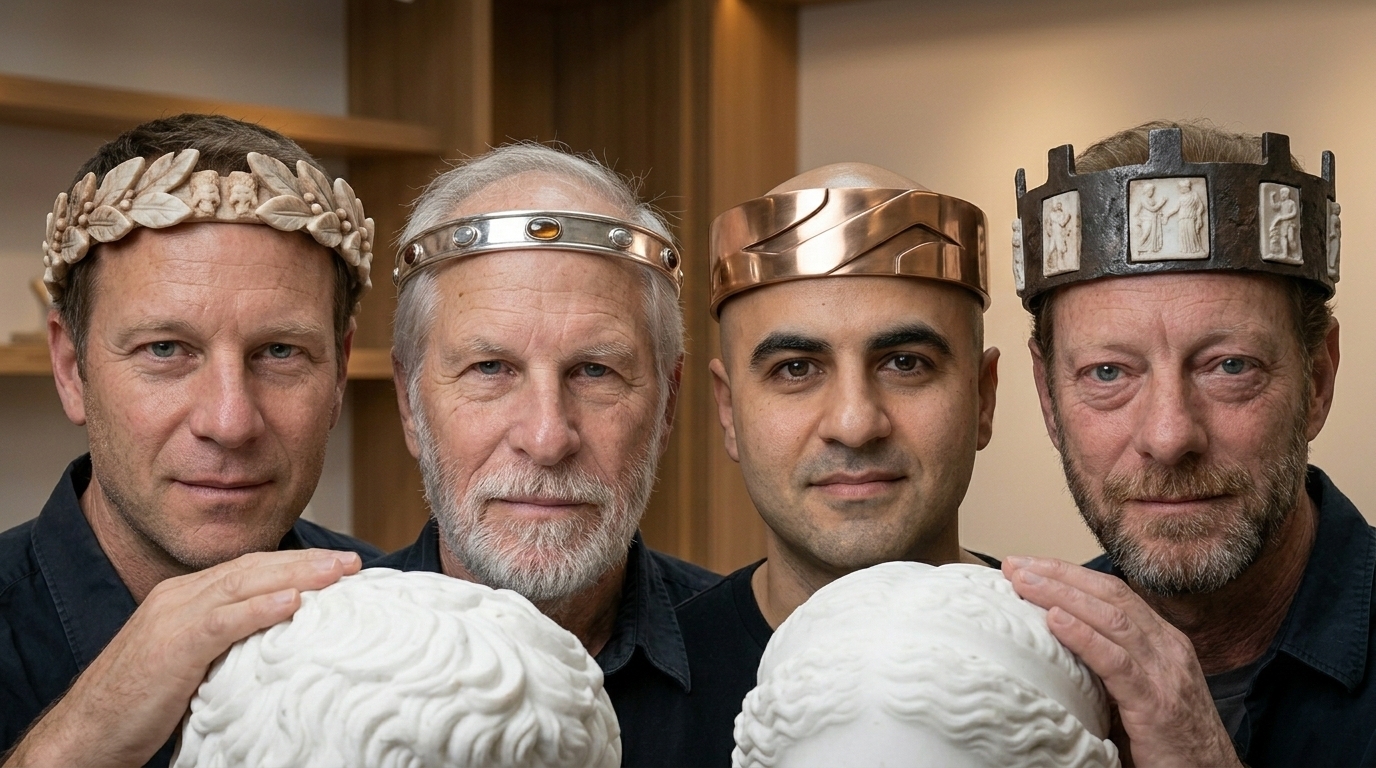

Every generation or so, sculpture comes roaring back. It happened with Rodin. It happened with Brancusi. Right now, in a world drowning in AI imagery and digital noise, four living artists are picking up chisel, clay, and bronze and doing what only a trained human hand can do: creating beauty so complete it stops you in your tracks.
These are not nostalgists. They are masters who have absorbed the classical tradition deeply enough to take it somewhere new. And the art world is starting to realize it.
Jago: The Man Who Makes Marble Breathe Again
Jago, born Jacopo Cardillo in Frosinone, Italy in 1987, does not just carve marble. He makes it feel alive. Working entirely by hand with traditional techniques, he has produced figures so realistic and emotionally loaded they belong in the same conversation as Michelangelo.
At 24 he was selected for the 54th Venice Biennale, where his marble bust of Pope Benedict XVI earned him the Pontifical Medal. In 2019 he became the first artist in history to send a marble sculpture to the International Space Station, as part of the European Space Agency’s Beyond mission. His studio in a 16th-century church in Naples is now officially the Jago Museum, drawing thousands of visitors who come specifically to watch him work.
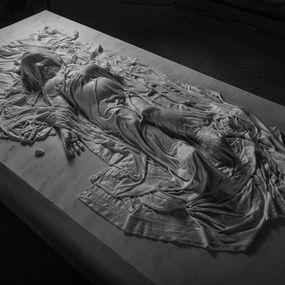
His Veiled Son, a child lying beneath a translucent marble veil carved from a single block of Vermont Danby marble, is a direct response to Sanmartino’s 18th-century Veiled Christ. It was gifted to the people of Naples and placed permanently in the Chapel of the Whites in the church of San Severo. In 2025, his plaster model of David opened at the Gallerie d’Italia in Naples, while the final Carrara marble version is in progress. He is also representing Italy at Expo Osaka 2025.
The art world calls him the new Michelangelo. He shrugs and keeps carving. When 4,000 young people queued in masks during a pandemic to see his work up close, it was clear he speaks a language that has not gone out of fashion. It never will.
Quality of Work: 97% | Contribution to the Revival of Classical Sculpture: 98%
Based on: institutional recognition (Venice Biennale, Pontifical Medal, Expo Osaka 2025), unique technical mastery in hand-carved marble, extraordinary public reach across social media and museum attendance, and the permanent gifting of major works to the public.
Sabin Howard: 38 Bronze Figures. 25 Tons. One Masterpiece.

Sabin Howard spent decades building a reputation as one of America’s finest figurative sculptors. Then he was handed the commission of a lifetime: the centerpiece of the National World War I Memorial in Washington, D.C.
What he produced is staggering. A Soldier’s Journey, unveiled on September 13, 2024 at Pershing Park, is 58 feet long, weighs 25 tons, and contains 38 larger-than-life bronze figures. Smithsonian Magazine confirmed it is now the largest free-standing high-relief bronze in the Western Hemisphere. Howard modeled every one of those 38 figures in clay himself, using live models in period uniforms who posed for months.
The piece reads left to right like a film: a daughter handing her father his helmet, soldiers charging into battle, the weight of wounds, a man finding his way home. At the unveiling, The American Legion reported that hundreds stood silent long after the ceremony ended, simply unable to leave. That is what great sculpture does to people.
Quality of Work: 96% | Contribution to the Revival of Classical Sculpture: 95%
Based on: creation of the largest high-relief bronze in the Western Hemisphere for a national public memorial, rigorous classical figurative training, decades of solo and group exhibitions, and documented public emotional impact at the September 2024 unveiling.
Peter Schipperheyn: The Man Who Still Travels to Carrara for Every Block

Michelangelo sourced his marble from the quarries of Carrara in Tuscany. So does Peter Schipperheyn. Every year, the Melbourne-born sculptor travels to Carrara to find the specific block he will carve next. Not any block. The right one.
Schipperheyn trained at the Accademia di Belle Arti in Carrara on an Italian government scholarship in 1979. He is now regarded as Australia’s pre-eminent sculptor of the human figure in marble, according to the National Portrait Gallery of Australia. His commissions include a marble relief honoring Dame Joan Sutherland for Sydney Town Hall, 14 Stations of the Cross for the University of Notre Dame, and an Eternal Flame in Australian granite for the Holocaust Centre in Melbourne.
He won the Wynne Prize, one of Australia’s most prestigious art awards, for two monumental Carrara marble heads. His work is in the permanent collection of the National Gallery of Victoria and collections across four continents. He says each block either speaks to him or it does not. That is not mysticism. That is the level of attention that connects a living artist to a tradition stretching back two thousand years.
Quality of Work: 94% | Contribution to the Revival of Classical Sculpture: 88%
Based on: unbroken continuity with the Carrara marble tradition since 1979, Wynne Prize recognition, major national public commissions, and permanent collection placement at Australia’s leading museum. Score reflects strong regional influence with lower international visibility compared to Jago and Howard.
Andrew DeVries: Four Decades of Getting the Human Body Exactly Right
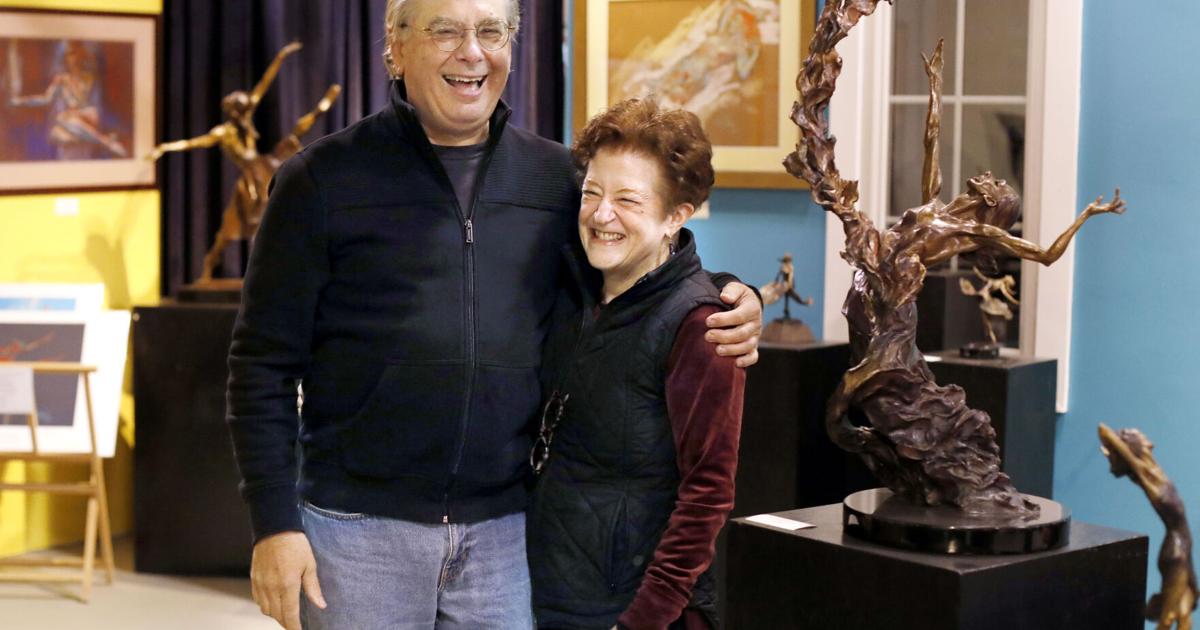
Most sculptors use commercial foundries. Andrew DeVries built his own foundry in the Berkshires of Massachusetts and casts every piece himself. That choice tells you almost everything about who he is.
Born in 1957 in Rochester, New York, DeVries left high school at fifteen and eventually discovered sculpture through ballet, spending two years sketching dancers daily in a Denver studio before apprenticing with sculptor Ed Dwight and later studying at the Paris-American Academy. His bronzes of the human body in motion have earned him the National Sculpture Society’s Young Sculptor Award, the Walter and Michael Lantz Prize, and the Lindsay Morris Memorial Prize.
His work is in the collections of the Library of Congress in Washington D.C., the National Museum of Dance in Saratoga Springs, the Gaiety School of Acting in Dublin, and the Ballettzentrum at the Hamburg Ballet in Germany. Works on six continents. Forty years. Not one shortcut taken.
Quality of Work: 92% | Contribution to the Revival of Classical Sculpture: 85%
Based on: four decades of rigorous figurative bronze work, institutional collections across six continents, multiple National Sculpture Society awards, and total control of the sculptural process from clay to finished bronze. Score reflects deep mastery with a more regional public profile than the other three artists.
The Next Golden Age Is Already Being Built
Four artists. Four countries. Marble, bronze, chisel, and clay. What connects them is a refusal to settle for anything a machine could do instead.
The sold-out programs at institutions like the Florence Academy of Art, the thousands queuing to watch Jago carve in Naples, the silence at Pershing Park in September 2024: these are not isolated moments. They are signs of something building fast.
The great age of sculpting is not behind us. It is being carved, right now, by people who chose the hardest way because they knew it was the only way that mattered.









Leave a Reply