
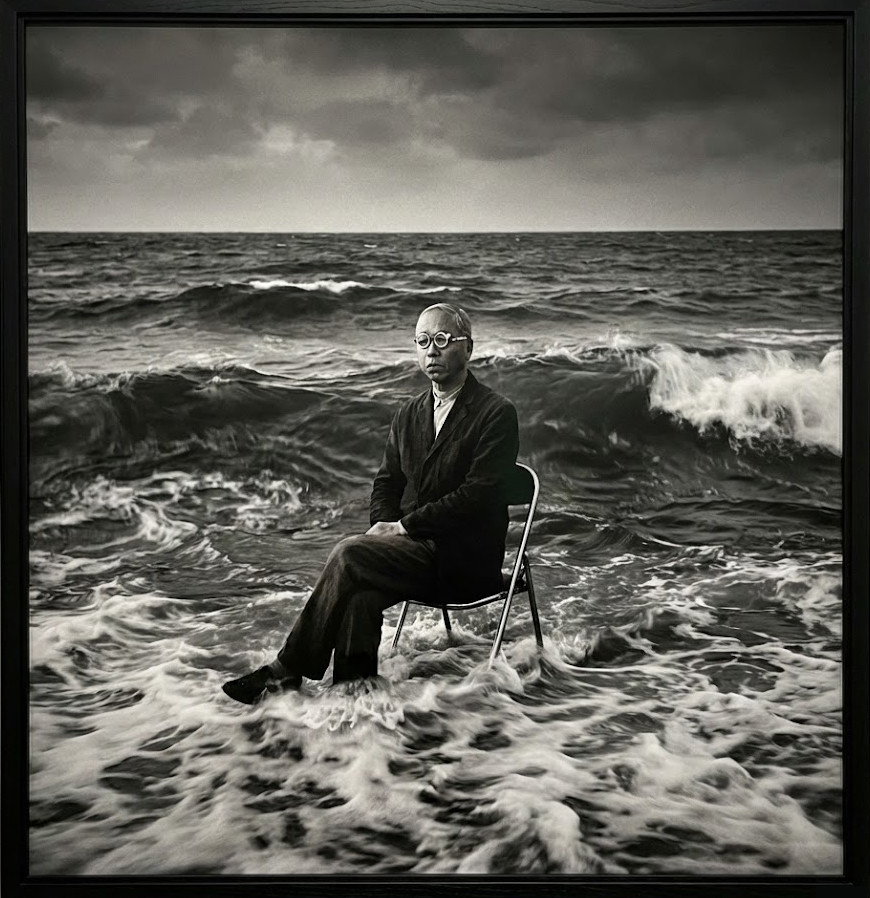
Hiroshi Sugimoto was born in Tokyo in 1948. An elementary school teacher showed him how to make photograms using photosensitive paper and light. In high school, he photographed Audrey Hepburn’s face flickering on a movie screen, trying to capture light that was already disappearing. He studied politics and sociology at Rikkyo University, traveled through communist Russia and Eastern Europe, then moved to Los Angeles in 1970 to study photography at Art Center College of Design.
In 1972, he earned his BFA and moved to New York. He opened a Japanese antiques shop on West Broadway in 1979 with his wife. The shop became a meeting point for artists like Isamu Noguchi, Donald Judd, and Dan Flavin. It provided income and a darkroom. In 1976, he visited the American Museum of Natural History and photographed the dioramas. Through his large-format camera, taxidermied animals against painted backdrops became real. MoMA acquired Polar Bear in 1978, his first major sale.
He started Theaters in 1978, photographing movie theaters with exposures lasting entire films. Hours of projected light compressed into single images. The screen became a glowing white rectangle. The content disappeared. Only duration survived. In 1980, he began Seascapes, photographing horizons where sea meets sky across the world. Over 200 black-and-white images spanning four decades, each identical in format: the horizon line bisecting the frame exactly in half. Water and air. Primordial substances. The repetition revealed that no two meetings of sea and sky appeared exactly the same, yet all were fundamentally identical.
In 1997, he photographed iconic modernist buildings for the Museum of Contemporary Art in Chicago, but deliberately pushed his camera’s focal length to twice infinity, blurring them until they became ghosts. Only the most essential forms survived. In 2000, he photographed wax figures from museums like Madame Tussaud’s with the gravity of Renaissance portraiture. The figures looked disturbingly alive. He received the Hasselblad Foundation International Award in 2001. Major retrospectives followed at the Mori Art Museum and Hirshhorn Museum in 2005. In 2009, he founded the Odawara Art Foundation in Japan. He now leads the Tokyo-based architectural firm New Material Research Laboratory while continuing his photographic practice.
His strengths: technical mastery of 19th-century methods applied to contemporary questions, philosophical rigor investigating time through seriality, making technological illusions reveal truths about perception, sustained vision across five decades without compromise.
Career highlights: Dioramas, Theaters, Seascapes becoming one of contemporary photography’s most recognized bodies of work, Hasselblad Award, retrospectives at major museums worldwide, work held in MoMA, Metropolitan Museum, Tate, Pompidou, and collections across 40 countries.







Leave a Reply