
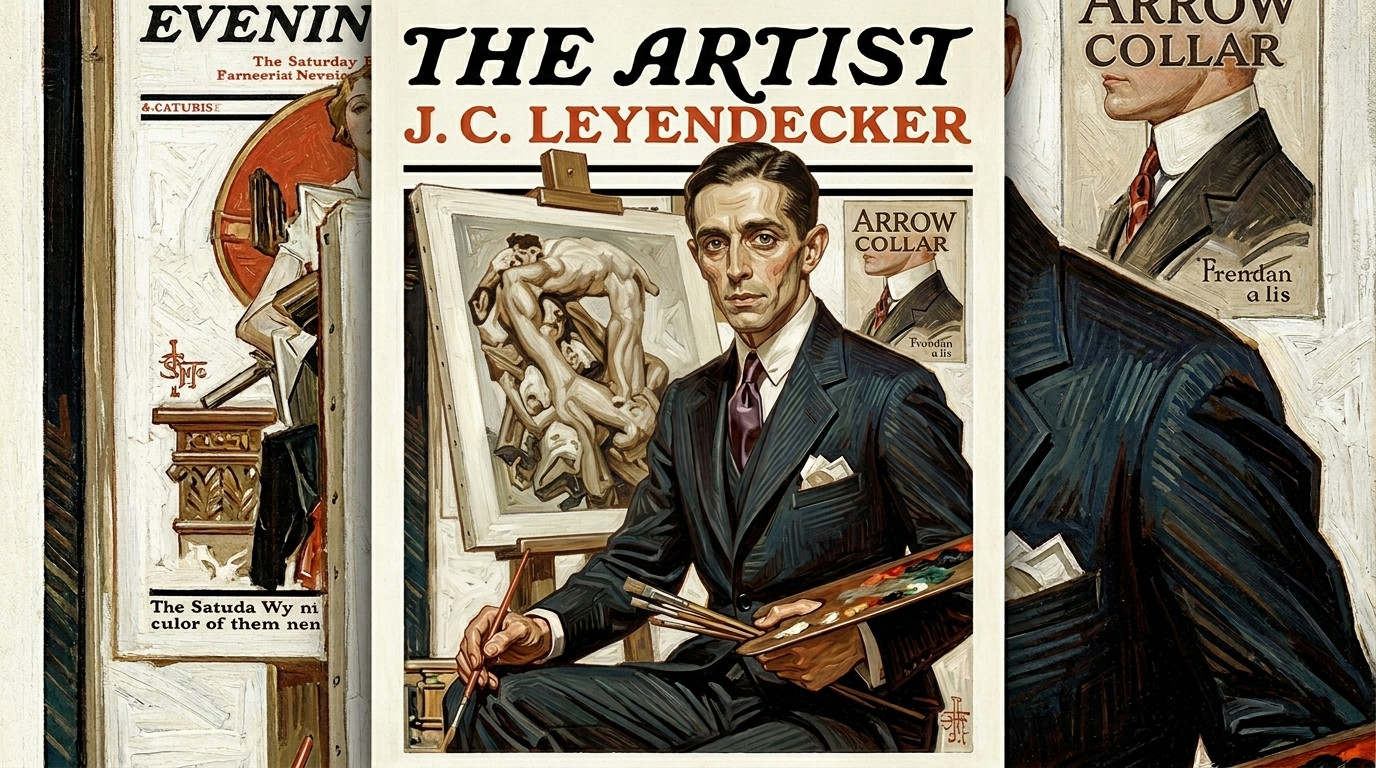

Before Norman Rockwell, before the Gap ad, before any studio photographer figured out how to make a man in a suit look like someone worth believing in, there was J.C. Leyendecker, standing in his New Rochelle studio, painting the same jaw from seventeen different angles until it looked like the kind of jaw that built things.
He painted 322 covers for the Saturday Evening Post over a 44-year relationship with the magazine, and did it while running one of the most successful advertising campaigns in American history. But the covers were almost a side arrangement, because the work that actually rewired how Americans saw themselves was the Arrow Collar campaign, a series of illustrations for a shirt company that produced one of the stranger cultural phenomena of the early twentieth century.
At the peak of the campaign in the early 1920s, the Arrow Collar Man was receiving 17,000 fan letters a month, along with gifts and marriage proposals. He was a drawing of a shirt.
The man in those ads had a specific quality that is hard to name but easy to feel, something between confidence and warmth, like someone who had already handled the difficult thing and wasn’t going to mention it. Leyendecker built that quality stroke by stroke, using a technique where his brushwork was almost sculptural, thick and directional, so the finished image had a physical weight that photography at the time simply couldn’t match.
Norman Rockwell, who eventually replaced him as the Post’s defining illustrator, spent years openly studying Leyendecker’s technique. He later said that more than any other artist, Leyendecker was the one he tried hardest to paint like and never quite could. Rockwell served as a pallbearer at his funeral.
Rockwell idolized him so completely that as a young man he would take the long train from New York to New Rochelle just to walk past Leyendecker’s house. Not to knock. Just to walk past it and think about the work being made inside.
The model for the Arrow Collar Man was Charles Beach, Leyendecker’s companion of fifty years, a tall and extraordinarily handsome man who managed his business, negotiated his fees, and eventually moved into the New Rochelle house with him. Leyendecker had quietly made his partner the face of American masculinity, printed in millions of homes every week, and nobody outside their circle knew.
And then, quietly, the world moved on. Illustration gave way to photography. The Saturday Evening Post shifted its tastes. Leyendecker spent his final years in the same house with Beach, increasingly cut off from an industry that had absorbed his entire visual vocabulary without crediting the source.
He died in 1951 with almost no money. His funeral was attended by five people. The four pallbearers were three of his former models and Norman Rockwell. Beach, who had been ordered to destroy all records and correspondence, sold what remained of Leyendecker’s original studies in a yard sale.
The aesthetic he invented had become the air by then, and air doesn’t get a byline.
1874 – 1951 · New Rochelle, New York


Leave a Reply