
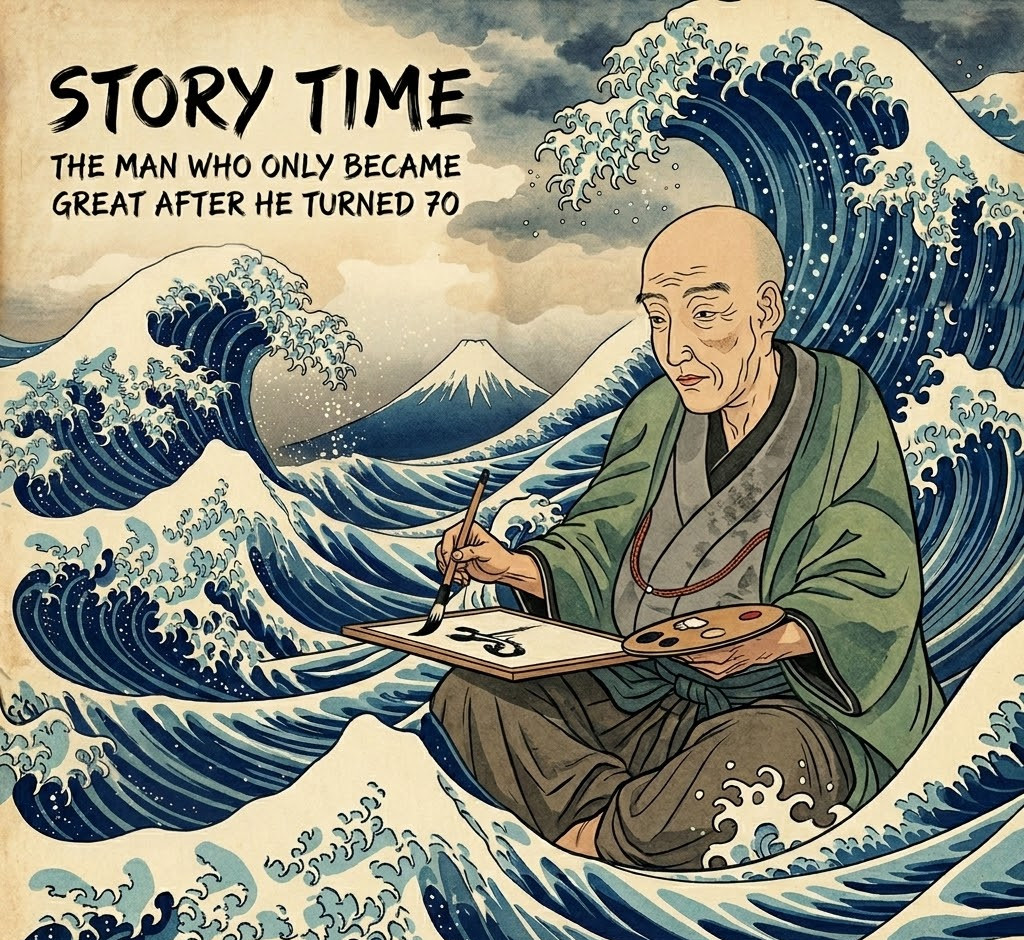

Katsushika Hokusai spent the first seven decades of his life convinced he had not yet made anything worth keeping.
Not the celebrated actor portraits. Not the illustrated novels that sold by the thousands in Edo’s busy markets. Not even the early landscape prints that collectors were already framing and hanging on their walls. He was dissatisfied in a way that wasn’t false modesty — the kind of dissatisfaction that quietly destroys most artists before it saves them.
He changed his artist name more than thirty times over his career. Each new name was, in his mind, a funeral for the person who had painted before, and a bet on whoever came next.
He moved house over ninety times. There is no obvious logic to this except the logic of someone who believed that his surroundings were conspiring with his habits to keep him mediocre, and that the only way to break the spell was to break everything else first.
In the preface to his sketchbooks at age 75, he wrote that everything he produced before seventy was, in his own words, not worth counting.
He was not exaggerating for effect. He genuinely meant it, which makes what happened next one of the stranger stories in the history of art.
Because somewhere around the age of 70, working in a cramped rented room — probably cold, definitely poor — he began the series that would eventually be reproduced on tote bags and tea towels and phone cases in every country on earth. He drew Mount Fuji thirty-six times and then, because that wasn’t enough, drew it ten more.
He called the series “Thirty-six Views” and quietly added the extra ten without changing the title, which says something about his relationship to completion.
The Great Wave off Kanagawa, arguably the most reproduced artwork in human history, was made by a man who considered his entire preceding career a warm-up act. He died at 89, reportedly saying he only needed a few more years to truly become a master.
The Great Wave is the one everyone knows — the curl of dark water with its foam claws and tiny Fuji in the distance looking almost embarrassed to be there.
What most people don’t know is that Hokusai was completely broke when he made it. His daughter Oi, herself a remarkable painter who has never received nearly enough credit, was almost certainly working alongside him in that same room.
The blue he used was a relatively new import from Prussia that he had only recently gotten his hands on. The blue is part of why the print still looks modern. He had no name for it except the name everyone used then — bero-ai, a Japanese mangling of Berlin blue — and he used it with the enthusiasm of someone who had been waiting their whole life for exactly that color.
He never stopped believing the best work was still ahead.
At 83, after surviving an illness he described as nearly fatal, he wrote a letter asking the gods for just ten more years. When that proved too much to ask for, he revised the request downward to five. Then to three.
He died the following spring, apparently mid-sentence, in the middle of a new drawing. There is no tidy moral here about patience or late blooming or any of the comfortable things we say about artists whose struggles turn out well in retrospect.
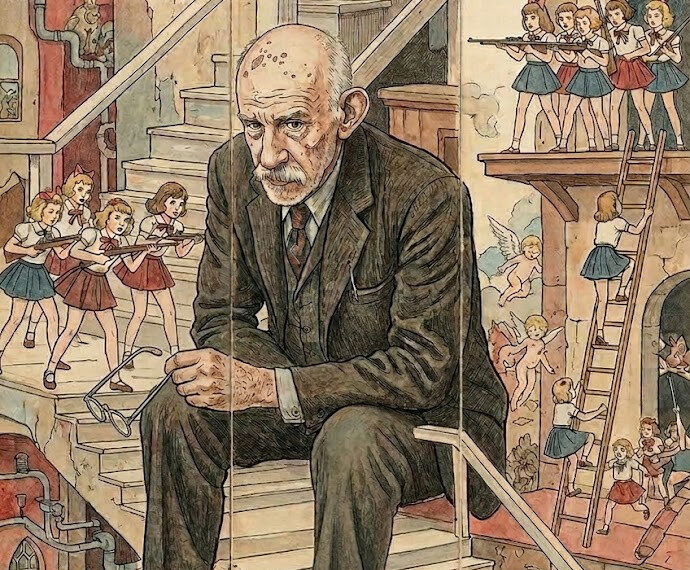
What there is, instead, is the image of a very old man in a cold room, genuinely excited about a new shade of blue, still convinced that the best version of himself was just a few brushstrokes away.
1760 – 1849 · Edo, Japan
Leave a Reply