
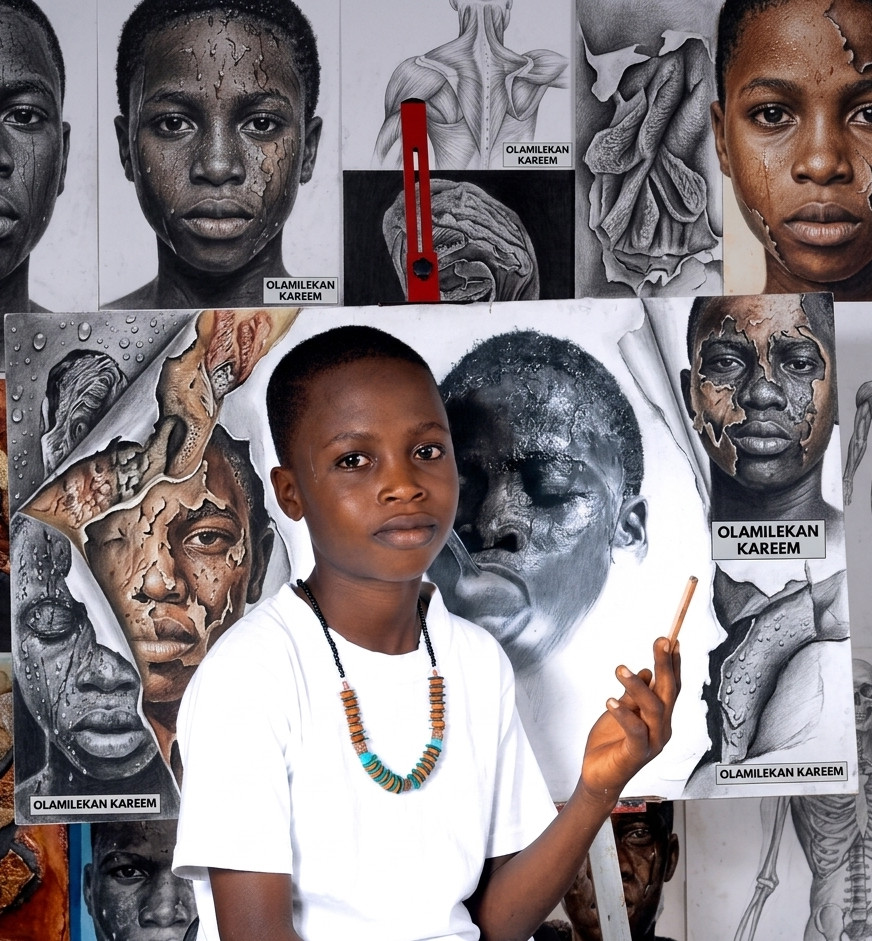

Most eight-year-olds are still figuring out how to tie their shoes. Olamilekan Kareem, a Nigerian artist now tracked by critics as one of the more compelling Gen Z visual talents, was eight when he decided to go professional. Not in the way children announce they want to be astronauts. He started earning money from his drawings. He had only been making art for two years at that point.
The story gets sharper from there. When French President Emmanuel Macron visited Olamilekan’s hometown, the boy, eleven years old at the time, produced a quick-draw portrait of him on the spot. The kind of thing that, if it goes well, becomes a photograph. If it goes badly, becomes an awkward moment nobody mentions again. It went well. The portrait circulated. People took notice.
From a Hometown Moment to an International StageThe Macron portrait did something more useful than make Olamilekan briefly famous. It created a paper trail of credibility at an age when most artists have nothing but promise. Galleries and foundations that support young artists need a hook, something that proves the talent is not just the enthusiasm of a proud parent. A presidential portrait, documented and dated, is a hook.
What followed was a string of recognitions that kept compounding. He entered the Global Child Prodigy Awards and won. He submitted work to Taiwan’s Chou Ta-Kuan Cultural and Education Foundation award, competing against 2,723 participants from around the world. He won that too, which earned him a meeting with Taiwan’s president, Tsai Ing-wen. Two heads of state before the age of fifteen.
Recognition Timeline
| Age 6 | Picks up a pencil for the first time and begins drawing |
| Age 8 | Goes professional, earning money from drawings after just two years of practice |
| Age 11 | Draws a live portrait of French President Emmanuel Macron during a hometown visit; image circulates internationally |
| Award | Wins the Global Child Prodigy Awards, one of the most competitive recognition programs for young talents worldwide |
| Award | Wins Taiwan’s Chou Ta-Kuan Foundation award, beating 2,723 global competitors; meets President Tsai Ing-wen |
Two heads of state before the age of fifteen. Not many artists, at any age, can say that.
The prodigy label is both a gift and a problem. It gets you through doors. It also sets an expectation that the work will always be remarkable for its youth rather than remarkable on its own terms. Many child artists burn through their early recognition and spend their twenties trying to be taken seriously as adults.
Olamilekan has navigated this more carefully than most. The years since his early fame have been spent building technical range rather than trading on novelty. He has moved beyond the portrait style that first attracted attention, experimenting with other forms and subjects, deliberately expanding what he can do before the world fully decides what he is. That is a smart instinct for an artist who got famous very early for a very specific skill.
Art as a Way Out, and Then a Way ForwardThere is a dimension to this story that the awards and the presidential handshakes do not fully capture. Olamilekan grew up without easy access to the resources that most art-world careers assume. He used his skill to work his way out of poverty. That is not a metaphor about following your passion. It is a literal economic path built drawing by drawing, recognition by recognition, in a context where most routes out were not open.
That background shapes how critics and curators now talk about his work. It is not just that the technique is impressive. It is that the technique was built under pressure, without the safety net of art school funding or family connections to galleries. Whatever he produces next carries the weight of that origin, and that tends to give art a specific kind of gravity that is very hard to manufacture.
A Generation Coming Into Its OwnOlamilekan is part of a broader cohort of Gen Z visual artists who are now entering the professional art world as adults after childhoods spent building their practices in public. What sets him apart within that group is that his public record started earlier and under more unusual circumstances than almost anyone else in his generation.
In 2026, art critics and collectors are watching this cohort with genuine interest. The question is no longer whether Olamilekan has talent. That was settled when he was eight. The question is what he does now that he gets to decide what his work is actually about, without a camera pointed at a president in the frame.

Leave a Reply