
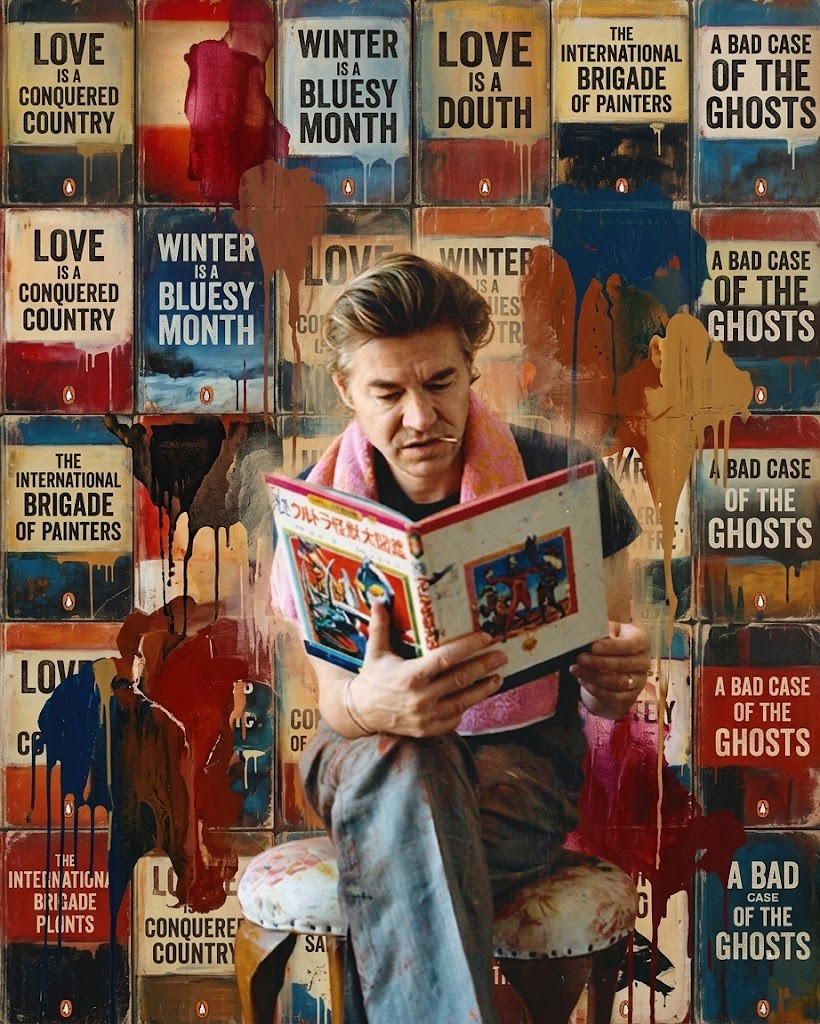

There is a specific kind of art-world success that happens slowly, inside the rooms of galleries and auction houses, and then one day spills out into the street. That is what happened to Harland Miller in 2025, except the street in question was a garden path in York, and the people walking it had no idea they were about to become new fans of one of Britain’s most distinctive painters.
Miller has been around long enough that the art world had already formed its opinion of him. His large-scale paintings, which layer acidic wit over mock Penguin paperback covers, had earned him a dedicated collector base and occasional museum interest. He was respected. He was collected. He was not exactly a household name.
A Floral Installation Nobody ExpectedThe shift came through a public installation in York Museum Gardens, one of those quietly beautiful urban green spaces that locals use for lunch breaks and tourists wander into by accident. Miller’s installation there in 2025 was not a painting. It was something looser, more approachable, built from flowers and color and language arranged in a way that stopped people mid-step. The photos spread online before any press release did.
People who had never bought art, never visited a commercial gallery, never heard the name Harland Miller, started sharing the images. The installation worked on them the same way a good poem works on someone who claims they don’t read poetry. It landed before they had the chance to decide whether it was for them.
The photos spread online before any press release did. People who had never heard the name Harland Miller started sharing the images.
The timing of the garden moment was not entirely random. Behind it was a longer arc of institutional recognition that had been building quietly. Miller had a major exhibition at York Art Gallery in 2025, titled Harland Miller: XXX, which placed his body of work inside a proper museum setting for the first time at scale. Shortly after, a show at the Design Museum in London examined his relationship with language, design and authorship, asking viewers to read his work rather than just enjoy it. Around the same time, a curatorial project called Textual Healing at the ICA added critical framing to what had long been appreciated mostly at the surface.
Then Phaidon published a major monograph. That is the kind of thing that signals to the art world that a career has passed from interesting to significant.
Key Milestones 2025 – 2026
| Exhibition | Harland Miller: XXX at York Art Gallery — first major museum survey of his work |
| Show | Language, design and authorship at the Design Museum, London |
| Project | Textual Healing curatorial project at the ICA — critical context for a practice long enjoyed at the surface |
| Monograph | Comprehensive career survey published by Phaidon |
| Installation | Viral floral work in York Museum Gardens reaches a mass, non-gallery public |
One of the more quietly significant moves Miller made around this time was ending his Penguin-format editions. Those small-scale, more affordable works had been how many people first encountered his practice — text-heavy compositions that looked like vintage paperback covers gone sideways, funny and melancholic at once. Stopping them created scarcity. It also sent a signal that he was done with the entry-level version of his own work.
Collectors noticed. When fewer works enter the market and institutional attention rises at the same time, the pieces that already exist get looked at differently. Galleries reported that attention shifted toward the strongest existing works rather than waiting for new supply.
What Made the Garden WorkThe interesting question is not why the garden installation went viral. Flowers photograph well. Public spaces give art permission to be seen without the anxiety of walking into a gallery. What is more interesting is why it stuck. People kept talking about it after the initial scroll.
Part of it is that Miller’s instinct for language travels. His work has always been about words placed somewhere they create a little dissonance — text that feels both familiar and slightly off, like a sign that has been subtly altered in the night. In a garden, surrounded by something as uncomplicated as flowers, that tension became easier to feel. The setting did some of the work the gallery walls usually obscure.
By the time 2026 arrived, Miller’s career was being described by critics and collectors as entering a more settled and confident phase. That is art-world language for: this is no longer a gamble. For an artist who spent years being quietly respected rather than loudly celebrated, the garden turned out to be the most effective introduction he never planned.
Where He Stands NowAs of 2026, Miller is considered one of the more secure bets among British contemporary artists by collectors who track the intersection of institutional momentum and market behavior. His work is being assessed more slowly and more carefully than it was a decade ago, which, in the art world, is usually the sign that it will last. The viral garden moment did not make him a celebrity. It made him legible to a much wider audience, and that is a different, more durable thing.


Leave a Reply