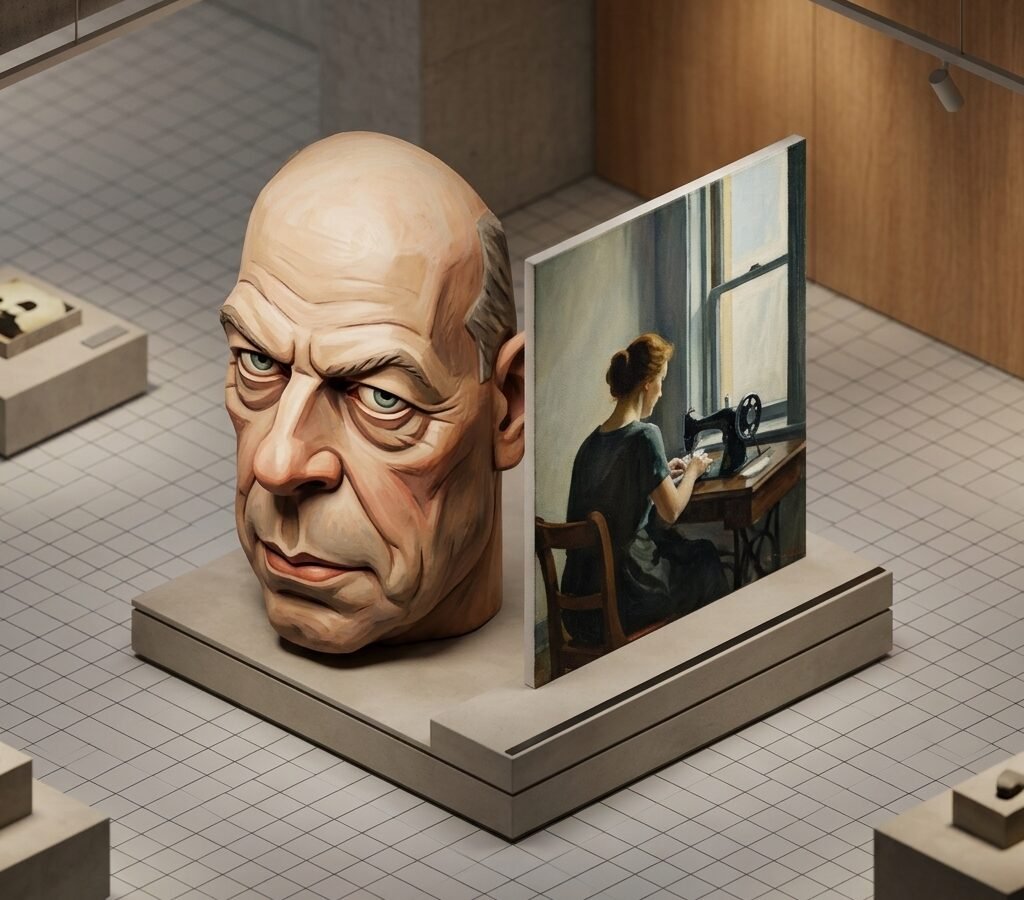
In 1906 a young art student in New York sat for a portrait by her teacher, Robert Henri, who called it simply The Art Student. Her name was Josephine Nivison, and one of the other students in that school was a tall, silent young man called Edward Hopper. Neither of them knew yet that they would spend forty years in the same small apartment, or that only one of them would be remembered.
For a long time it looked like it would be her. In the years after art school Jo exhibited in New York next to Picasso, Man Ray and Modigliani, while Edward still described himself in the artists’ directories as an illustrator and paid his rent drawing for magazines. They met again in the summer of 1923 in Gloucester, Massachusetts, two painters in their forties painting the same harbour. That autumn the Brooklyn Museum invited her to show her watercolours, and she asked them to take his as well. They did, and they bought one. It was the first painting Edward Hopper had sold in ten years.
They married the next year. From then on almost every woman in his paintings was Jo, whether she was the usherette leaning against the wall of a cinema, the woman alone on a bed in a hotel room or the figure staring out of a window at eleven in the morning. She posed for hours in their cold studio, wrote down every painting he made in a set of ledgers with her own comments next to his titles, talked to the journalists he didn’t want to talk to and negotiated with the dealers. Her own painting slowed down to a few watercolours a year, painted in the corners of the days that his work left free.
Edward died in 1967 and Jo less than a year later, twelve days before her eighty-fifth birthday. She left everything to the Whitney Museum: his three thousand works and every painting of hers she had kept. The museum put his in the permanent collection, and most of her canvases were thrown away. A portrait she painted of Edward reading his favourite poet is among the works that exist today only as old black and white photographs, collected by the art historian Gail Levin, who spent years tracing what was lost.
In 2000 a researcher went down into the Whitney’s basement and found about two hundred of her works that had escaped, sitting in storage where nobody had looked at them for thirty years. They have since been shown, slowly, in small museums. The woman in Nighthawks has been looked at by millions of people, while the woman who painted Railroad Gates, Gloucester is still waiting for her first big wall.
More lives that the official story left out are in our Story section, from the illustrator who invented the American face to the painter who only became great after seventy. And if you’d rather meet the work before the name, start with Experience.