
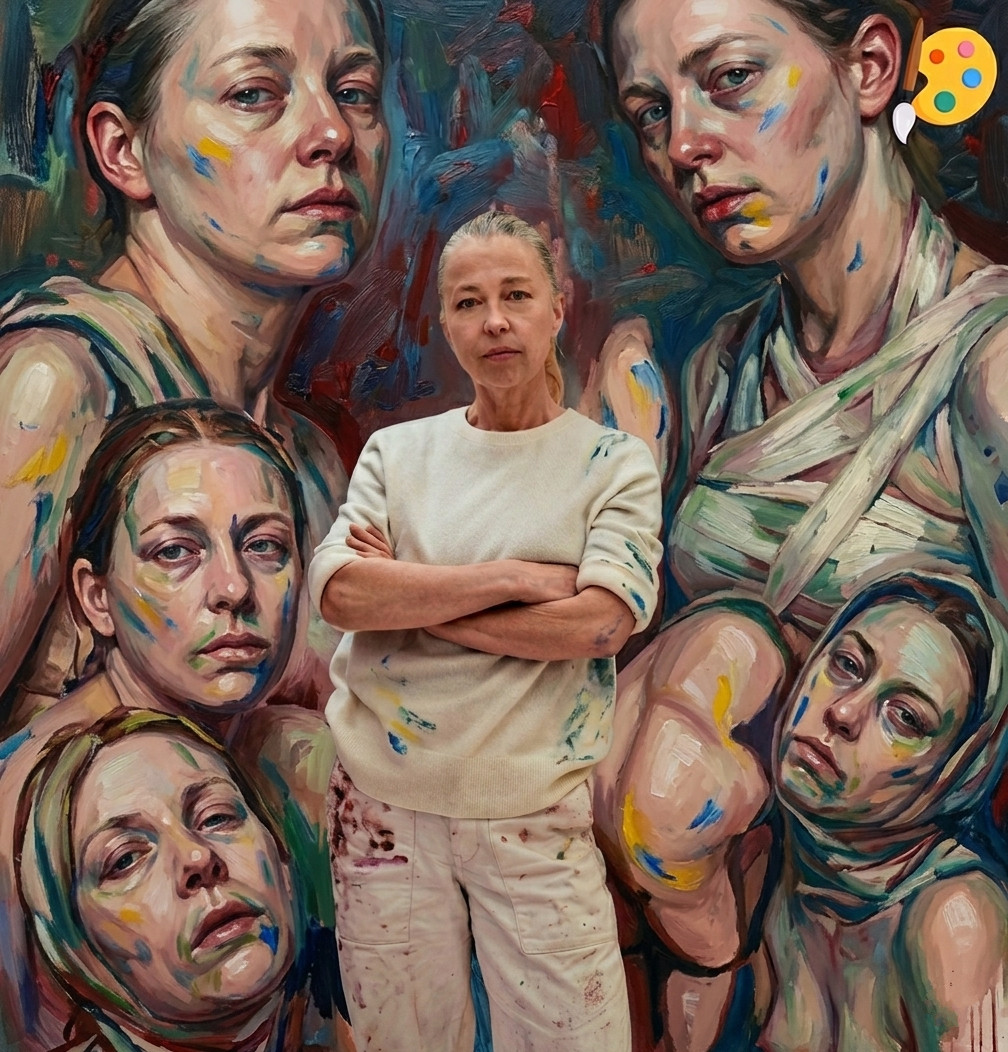
Jenny Saville was born on May 7, 1970, in Cambridge, into a family of educators who moved frequently as her father pursued a career in school administration. She was eight years old when she first got hooked on painting, and her mother, recognizing something real in that, cleared out a broom closet at home to give her a first studio. Her uncle, an artist and art historian, took her to museums and eventually to Holland and Italy, putting the Old Masters in front of her eyes before she was old enough to fully understand them.
She studied at the Glasgow School of Art from 1988 to 1992, where she was awarded a six-month scholarship to the University of Cincinnati and enrolled in a women’s studies course — an experience that quietly shaped everything that came after. Her graduate show sold entirely, and one of her paintings ended up on the cover of The Times Saturday supplement. Within weeks, collector Charles Saatchi had purchased her entire available body of work and commissioned a new series. For a painter barely out of school, that was a rare and defining kind of attention.
What makes Saville stand out isn’t just ambition or scale — it’s the way she looks at the body without flinching, without flattering, and without apologizing. Her canvases, usually six by six feet or larger, are strongly pigmented and give a sensual impression of skin’s surface and the mass of the body. Her post-painterly style has drawn comparisons to Lucian Freud and Rubens, though the comparison only goes so far. Her paintings refuse to fit smoothly into any historical arc. Each body comes forward, autonomous, voluminous, always refusing to hide.
She collects material from pathology textbooks, plastic surgery manuals, and chronicles of burns and injuries, and has attended surgery demonstrations and visited butcheries to sharpen her observational eye. That sounds clinical, but the work is anything but. There is raw, physical intelligence in every brushstroke — a painter who understands that flesh is not just form but experience, memory, vulnerability.
Her work now belongs to the Metropolitan Museum of Art, The Broad, the San Francisco Museum of Modern Art, and the Norton Museum of Art, among others. She was appointed lecturer at the Slade School of Fine Arts between 2000 and 2006, and was elected a member of the Royal Academy of Arts.
Best Artworks
1992 · Oil on canvas
Her defining early work. A self-portrait with a text from French feminist philosopher Luce Irigaray written in reverse across the canvas. It sold in 2018 for £9.5 million at Sotheby’s London, setting the record for the most expensive work sold at auction by a living female artist.
9.5 / 10
1993 · Oil on canvas, 9 × 7 ft
A nude female figure mapped with surgical contour lines referencing the markings drawn on the body before liposuction. Strange, uncomfortable, and completely unforgettable. It was the signature piece in the Young British Artists III exhibition at the Saatchi Gallery in 1994.
9.0 / 10
Strategy (South Face / Front Face / North Face)
1994 · Oil on canvas, triptych
A triptych of a female body seen from three angles, monumental in size and confrontational in tone. It became iconic enough that the Manic Street Preachers used it on the cover of their album The Holy Bible.
8.5 / 10
1998–1999 · Oil on canvas, 261.6 × 487.7 cm
An enormous pile of intertwined bodies across a single canvas spanning nearly five meters wide. One of the most physically overwhelming works she has ever produced, and a strong case for why scale is not just a stylistic choice for Saville but a philosophical one.
8.5 / 10
2004–2005 · Oil on canvas
A key example of how she uses aggressive scale and wide brushstrokes to meditate on trauma and identity. The gaze stays with you. The Manic Street Preachers used it on their 2009 album Journal for Plague Lovers, though several UK supermarkets refused to stock the CD with the cover visible.
8.0 / 10
1995–1996 · C-prints, collaboration with Glen Luchford
A collaboration with photographer Glen Luchford, depicting a larger female nude lying on plexiglass and photographed from underneath, the body distorted by pressure and glass. Technically not a painting, but one of her most haunting and original projects.
8.0 / 10
Certified Overall Score
One of the few living painters who genuinely changed what figurative painting can do.
9.2 /10

Leave a Reply